1. Executive summary
The telecommunications market plays a vital role in enabling consumers in Scotland to access an extensive range of goods, services and markets, including healthcare, social security, banking, education, retail, social networks and entertainment. Access to these markets is critical to consumers’ wellbeing, to enabling their active participation in the economy, and to supporting citizens’ access to vital public services.
Over the past two decades there has been extensive rollout of a wide range of fixed and mobile technologies across Scotland. This has transformed how consumers access and interact with services and many consumers benefit from access to high speed, reliable and affordable telecommunications services.
However, consumers in Scotland can face a range of challenges with accessing telecoms services. While there has been recent improvement, some consumers in Scotland can face geographic disadvantages compared to those in other parts of the UK, with many rural and island communities in Scotland experiencing particularly significant challenges across both broadband and mobile markets. Other consumers face barriers to accessing digital markets and to maximising the benefits while mitigating the risks, due to limitations in cost, confidence and digital skills.
Ongoing action is needed to tackle connectivity gaps, improve access, and boost digital inclusion, reducing the digital divide and allowing consumers in Scotland to participate fully in an increasingly digital society and economy.
While real terms prices have fallen in certain key markets, purchase decisions are becoming increasingly complex, with more options for consumers to choose from. Levels of competition in the market are not uniform across the UK; many areas in Scotland, especially rural and island communities, have lower levels of coverage from more than one provider in both broadband and mobile markets. This can reduce the ability of consumers to move providers in search of a better deal.
Consumers need access to accurate information about provider coverage and about their own usage to support good purchase decisions. In order for consumers to benefit from the advantages of a competitive market, they will often need to take actions such as switching, renegotiating or reconfiguring bundled contracts. Not all consumers are able to confidently negotiate, and further support is needed to help consumers get the best deals available for them.
Where competition is not effective, there is a risk of market stagnation and poor consumer outcomes. Consumers need clear pathways to resolve issues where things have gone wrong. Levels of consumer detriment in the telecommunications market remain relatively high, indicating a need for continued consumer protection and effective enforcement.
Given ongoing cost of living pressures experienced by consumers, affordability remains an issue. A lack of affordable access to data or devices, a lack of skills or digital confidence, or a lack of motivation to use the internet can all contribute to digital exclusion, leading to a lack of access to wider services and opportunities.
In this report we present a package of recommendations aimed at ensuring equitable access to telecommunications services for consumers in Scotland. Equitable access can allow everyone to take up opportunities to work, connect and contribute to our society and communities.
Connectivity
While the rollout of broadband services continues to gather pace, gigabit and superfast coverage continues to lag significantly in rural and island areas of Scotland and presents a clear risk of digital inequality. The gap in gigabit coverage for rural Scotland is particularly pronounced. There also remain around 10,000 premises in Scotland who still cannot receive even a “decent” broadband service using either fixed line or fixed wireless access technology. This can create barriers to consumers accessing services, including challenges associated with the operability of energy smart meters.
Access to “decent” broadband speeds is delivered via the Broadband Universal Service Obligation (USO), which is due to be reviewed. We recommend that this review commences in 2026 and that it raises the speeds specified in the USO to at least the equivalent of Superfast Broadband levels, to support effective consumer confidence and participation across the economy and society. Any review should draw on the possibilities offered by developments such as the rollout of satellite technology, standalone 5G and 6G mobile services to enable “hard to reach” properties to access reliable telecommunications services. It is also important that USO connections remain affordable to ensure services are accessible to as many consumers as possible and to prevent detriment.
We recommend continued detailed monitoring and reporting on any revised USO, as well as improvements to consumer information so that consumers can better understand when various technologies are expected to be available to them. The Scottish Government should build also upon the outcomes of the Broadband USO, updated information on Planned Network Deployments by Providers and the outcomes of the Mobile Markets Review to refresh Scotland’s Full Fibre Charter. This must clearly identify the actions it, and partners, will take to improve connectivity.
Both 4G and 5G mobile coverage in Scotland also lag behind other UK nations, with Scotland having the highest number of landmass areas lacking coverage in mobile services. Both the UK and Scottish Governments have funded work to improve mobile connectivity, but coverage and performance remain at their lowest in rural areas. This impacts on the experience of consumers in Scotland. Further action by governments, providers and regulators is needed to assess coverage and performance levels of 4G and 5G provision in Scotland and identify priority areas for further investment. Following the publication of the most recent work on planned network deployments, and the conclusion of the Mobile Markets Review, Ofcom should establish nations-level benchmarks for mobile performance to accompany its proposed 90% UK benchmark to ensure delivery of significant performance improvement in Scotland and the other UK nations. The Scottish and UK Governments should work together to identify and agree priority areas for further investment both by providers and governments to meet these benchmarks. Decisions must draw on the possibilities offered by new technologies such as 5G standalone services, future 6G rollout or direct to device satellite calling to identify the most cost-effective solutions for “hard to reach” areas.
Supporting consumers during technology upgrades
The retirement of legacy technology such as the 2G and 3G mobile phone networks and older generation landlines poses challenges for both providers and consumers. Consumers need better information to help them understand what is changing and what action they need to take.
Consumers in rural areas of Scotland could be at risk of harm due to the switchover to digital landline calling and the retirement of 2G and 3G services adds another layer of complexity when looking at overall resilience of services. Throughout these network upgrades, technology must support consumers’ needs for uninterrupted access to calling and messaging services, connected health care services and critical public services.
Issues in the retail market
Advances in technology and increased competition between providers are allowing consumers to access better quality services for lower prices. Effective switching at the end of any fixed term contract can help consumers get best value, but consumers need accessible information about what deals are available and best meet their needs. Consumers can find it difficult to access this information and negotiate deals. Where contracts allow mid-term increases, it can be difficult for consumers to understand the effect of these provisions. Without measures to promote more transparency, consumers in vulnerable circumstances risk missing out on the best deals, meaning that they pay more for their services.
Given the importance of telecommunications services in consumers’ daily lives, the services received must be of appropriate quality. There must be clear ways for consumers to raise issues where things go wrong or where they are dissatisfied with the services they receive. While the UK Government has set out clear expectations of providers as part of a new Telecoms Consumer Charter, the Consumer Detriment Survey indicates that issues with internet provision, mobile telephone services and TV and other digital subscriptions all cause significant detriment to consumers.
The telecommunications sector can also improve the way it responds to the needs of consumers in vulnerable circumstances. We recommend that Ofcom urgently refresh its guidance on supporting consumers in vulnerable circumstances, building on the Charters developed by the UK Government and telecoms industry. Clearer guidance across issues such as pricing, contractual terms and debt recovery practices is needed and new guidance should clearly set out Ofcom’s approach to how consumers can be encouraged to share relevant information about their needs with providers and the actions providers should take.
Digital Exclusion and Affordability
Digital exclusion continues to affect consumer access to public and private services. Public Service Reform in Scotland offers opportunities to transform service delivery. However, action will be needed to ensure that reforms are rigorously assessed for their impact and user-tested to ensure inclusive design. This should include building in provision of assistance to access digital public services from the start to avoid some consumers being excluded from services. Affordability of telecommunications services remains a key issue. While the number of social tariffs available has increased, a lack of consumer awareness continues to dampen take-up. Although the price of broadband and mobile services has fallen in real terms, and broadband and mobile social tariffs offer a safety net for those struggling with their bills, for many on very low incomes the price of connectivity still remains too high.
Consumer Scotland recommends that the UK Government and Ofcom continue to work with providers to raise awareness and take-up of social tariffs. Ongoing monitoring will be needed and Ofcom should also consider whether the makeup of social tariffs and the allowances included reflect what consumers need to undertake work, engage socially and access public services. We also recommend the zero rating of essential public services websites so that consumers can access these sites without needing data.
The Scottish Government should also work to boost affordable access to devices and access to affordable (and where necessary free) data.
2. Background
About us
Consumer Scotland is the statutory body for consumers in Scotland. Established by the Consumer Scotland Act 2020, we are accountable to the Scottish Parliament. The Act defines consumers as individuals and small businesses that purchase, use or receive in Scotland goods or services supplied by a business, profession, not for profit enterprise, or public body.
Our purpose is to improve outcomes for current and future consumers, and our strategic objectives are:
- To enhance understanding and awareness of consumer issues by strengthening the evidence base
- To serve the needs and aspirations of current and future consumers by inspiring and influencing the public, private and third sectors
- To enable the active participation of consumers in a fairer economy by improving access to information and support
Consumer Scotland uses data, research and analysis to inform our work on the key issues facing consumers in Scotland. In conjunction with that evidence base we seek a consumer perspective through the application of the consumer principles of access, choice, safety, information, fairness, representation, sustainability and redress.
Consumer Principles
The consumer principles are a set of principles developed by consumer organisations in the UK and internationally. To inform our approach and that of others Consumer Scotland has adopted a set of consumer principles, drawing on the internationally recognised principles adopted by the UN General Assembly, to underpin our policy analysis and development and help assess the consumer interest.
Consumer Scotland uses the Consumer Principles as a framework through which to analyse the evidence on markets and related issues from a consumer perspective.
The Consumer Principles are:
- Access: Can people get the goods or services they need or want?
- Choice: Is there any?
- Safety: Are the goods or services dangerous to health or welfare?
- Information: Is it available, accurate and useful?
- Fairness: Are some or all consumers unfairly discriminated against?
- Representation: Do consumers have a say in how goods or services are provided?
- Redress: If things go wrong, is there a system for making things right?
- Sustainability: are consumers enabled to make sustainable choices?
Objectives of this review
Since our inception in 2022, Consumer Scotland has undertaken work on a range of telecommunications issues on behalf of consumers in Scotland. Our work has included advocacy on access to telecoms services, pricing, competition, safety, resilience and redress. Following these specific pieces of work, we wanted to assess the overall consumer experience of purchasing and using telecommunications services in Scotland. This review, which has comprised an in-depth examination of the existing evidence base, delivers our assessment of the current situation for consumers in Scotland: It:
- Identifies the key issues affecting telecommunications consumers in Scotland
- Assesses the effectiveness of current policy and regulatory responses to these issues
- Recommends priority areas for further action which can improve outcomes for telecoms consumers in Scotland
The work is intended to provide evidence and insight that will inform the actions of regulators, governments, industry and other stakeholders. It will also inform Consumer Scotland’s future research, policy and advocacy priorities in the telecommunications market.
Telecoms as a vital consumer service
UK adults spent an average of 4 hours and 20 minutes a day online in May 2024,[1] an increase of almost an hour from the September 2019 level of 3 hours and 29 minutes.[2] As the internet plays an increasingly central role for people carrying out everyday tasks such as purchasing goods, accessing services and communicating, consumers have an ever-growing need for high quality internet and mobile services. Faster, more reliable telecommunication networks, with greater geographic reach, can support innovation, transformation of public service delivery, and access to better business and leisure services. These networks allow consumers to remain in touch with friends and family and play an important role in maintaining access to critical national services such as healthcare or emergency services.
In the round, the availability of fast, reliable and affordable telecommunications for consumers, businesses and service providers underpins key purchasing, investment and delivery decisions and is a key driver of economic growth and efficient public service delivery.
Ensuring equitable access to these networks for consumers across the nations and regions of the UK is essential, to enable all consumers to access opportunities to work, connect and contribute to our society and communities.
3. Telecommunications services and markets
Telecommunications services in Scotland are provided by a variety of technologies, including fixed-line, mobile telephone, wireless and satellite connections. A short description of the current deployment of these technologies in Scotland is provided below. This provides the context for the following sections, which examine how well these technologies are currently serving consumers.
Landlines and Fixed Line Broadband
Fixed-line (“landline”) connections to residential and business premises were historically the main broadband service used by consumers. These are provided by Openreach’s network, made up of copper cable, ducts and poles. With the arrival of high-speed broadband internet access, fixed-line connections are now also provided by fibre-optic and coaxial cables which carry voice and data transmissions. Openreach was originally owned by BT but is now a separate company under the BT group. Openreach maintains and builds the phone and broadband infrastructure and it is required by the regulator Ofcom to make this infrastructure available to competitors. It has been estimated that more than 650 service providers use the Openreach network, including major internet service providers (ISPs) such as BT, TalkTalk, Plusnet and Sky.[3]
The telecommunications regulator, Ofcom, has also encouraged competitors to build their own networks, rather than relying on network access from Openreach. Virgin Media O2 provides cable and fibre broadband services and cable landlines. Through a combination of its own network and access to open-access wholesale fibre networks, the company’s combined fixed-line broadband covers more than 18 million homes across the UK.[4]
More recently, alternative network (“altnet”) services have emerged, which offer both retail services as ISPs and wholesale services. Altnet services are now available across around one third of the UK, through approximately 100 operators. Provision is dominated by a small number of larger operators, such as CityFibre, Hyperoptic, and Community Fibre, although there are also a large number of smaller altnets.[5]
Mobile, Wireless and Satellite Services
In addition to fixed line services, telecommunications services are also provided using mobile telephone technology. Mobile network operators (MNOs) own and manage the physical infrastructure for the mobile telephone network; these are EE, O2, Vodafone and Three.
In addition, there are a range of mobile virtual network operators (MVNOs) who resell mobile telephone services using MNO infrastructure. Many of these are provided by widely recognised companies, including Tesco Mobile, Lebara, TalkTalk or Sky mobile.
MNO and MVNOs provide their services using a variety of digital wireless communications technologies. These include voice and messaging services delivered via 2nd generation (2G) to 5th Generation (5G) services. This technology also provides Fixed Wireless Access (FWA), a wireless internet-only connection delivered via 4G or 5G technology that provides internet services from a mobile telephone mast to an antenna or router installed at the customer’s premises.
An expansion of FWA networks offering high-speed broadband services (of at least 100 Mbps download speeds) is underway with nearly 7,000 FWA masts being planned or upgraded across the UK between January 2026 and January 2029.[6]
Telecommunications services can also be provided by either Geostationary Orbit (GSO) or Low Earth Orbit (LEO) satellite services. GSO services are provided by companies such as Brdy, Eutelsat-Konnect, Northsat and Freedomsat, and LEO services in Scotland are provided by Starlink and OpenWeb.[7] Ofcom has consulted on expanding spectrum availability for GSO satellite gateway earth stations across most of the UK landmass, predominantly in rural areas with low population density..[8]
Ofcom has recently authorised direct LEO satellite to mobile phone connections,[9] with Vodafone and O2 being licensed to undertake “direct-to-device” satellite telephone calls.[10] Satellite direct-to-device services have the potential to provide basic connectivity to mobile handsets in areas outdoors where there is currently no coverage by terrestrial mobile networks - and therefore could potentially improve connectivity in rural “not spots”. However, Ofcom cautions that these services are still at an early stage of development. In the short to medium term, the focus is expected to be on SMS and low speed data services (under 500kbps) which can be used for services such as messaging apps. Voice services are intended to be introduced as the technology and satellite constellations mature. As a result, it is unlikely that direct-to-device satellite services will be used to support broader connectivity needs in the near future. [11]
4. Connectivity in Scotland – how well is it working for consumers?
This chapter outlines the current rollout and availability of broadband and mobile coverage across Scotland. It provides a comparison between Scotland and other UK nations and between urban and rural areas, identifying areas where coverage is weaker. It also addresses consumer issues as a result of the retirement of legacy technologies such as the move to digital voice calling and the retirement of 2G and 3G mobile services.
The Urban-Rural Gap
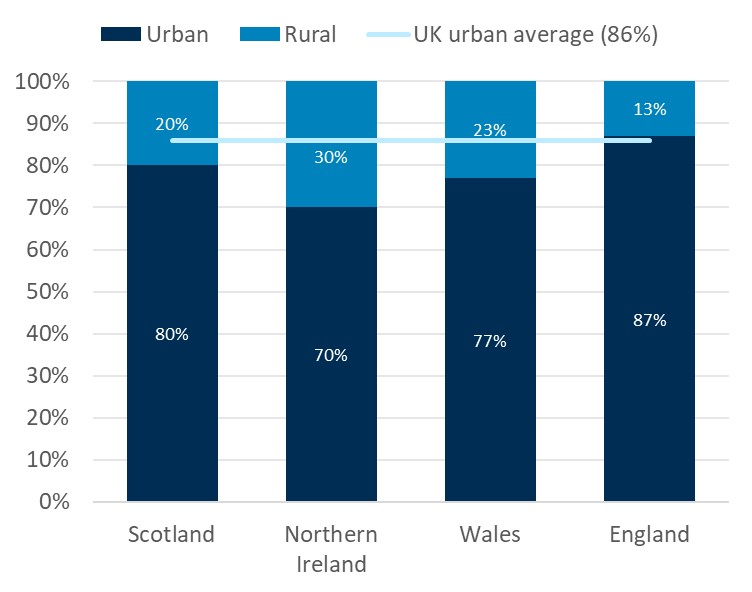
Of the 32.5 million premises with access to fixed broadband services in the UK, 2.9 million of these are in Scotland.[12] In Scotland, as in the other devolved nations, there are a significant number of rural telecommunication services consumers. Ofcom estimates that there are 590,801 rural telecommunications consumers in Scotland, representing 20% of all consumers in Scotland.
Communications issues have particular relevance for rural consumers. Rural areas often have more dispersed populations and residents may need to travel longer distances to access goods and services. Public transport infrastructure to facilitate this can be more limited, meaning that rural consumers have a greater reliance on online services. Reliable communications systems are needed for rural consumers to secure their safety and peace of mind, carry out social engagements and undertake work and business activities. Ofcom highlights that connectivity also supports the sustainability of rural communities, allowing business to grow, innovate and compete, while rural communities depend upon successful businesses to support jobs, services and long-term economic resilience. [13]
Chart 1: One in five telecommunication services consumers in Scotland live in rural locations
Urban-rural split of premises with fixed broadband access, by UK nation
Source: Ofcom (2026) Connected Nations: Spring Update 2026, interactive report
Broadband Connectivity
There are various broadband speeds available to consumers in Scotland, including Superfast and Gigabit. The Broadband Universal Service Obligation (USO) is designed to offer an affordable minimum standard of service. The levels of coverage for these service across Scotland as a whole, and the speeds they offer, are set out below, with later sections providing more detail on each technology. We provide an assessment of the effectiveness of the rollout of the individual technologies and of the current state of the network as a whole.
Table 1
Percentage of premises in Scotland with access to gigabit, superfast and USO broadband
| Speed | Percentage of premises in Scotland | Download speeds (megabits per second) |
|---|---|---|
| Gigabit | 82% | 1,000 |
| Superfast | 97% | 30 |
| USO | 98% | 10 |
Gigabit Capable Broadband
The roll-out of gigabit-capable broadband continues to be the primary focus of industry; by January 2026 gigabit-capable broadband coverage had grown to over 28 million consumers, or 88% of all UK premises.[14] A gigabit data connection offers download speeds of at least 1Gbps (1 billion bits per second) and the term is commonly used to describe cable, full-fibre or fibre-to-the-premises (FTTP) broadband.
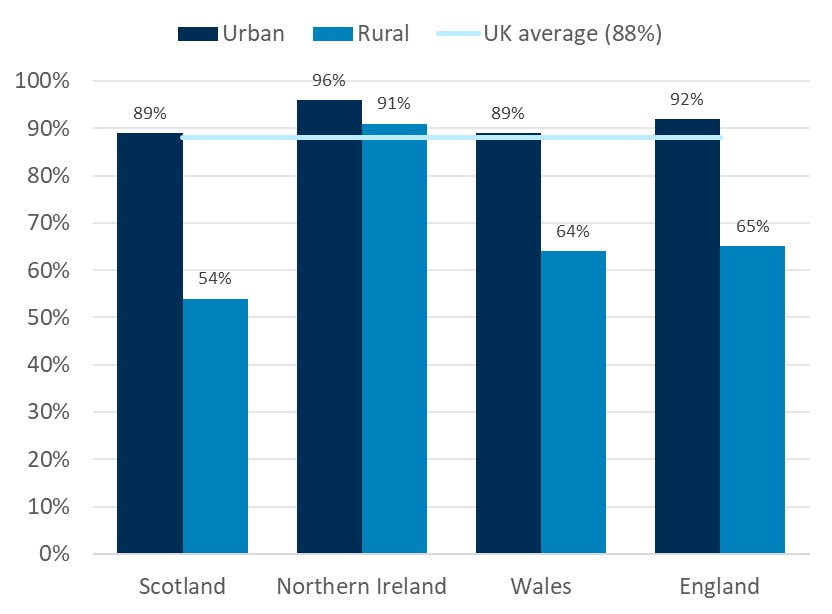
In Scotland, 82% of all premises, or 2,409,146 premises can access gigabit-capable broadband, but there is a significant gap in coverage between urban consumers and rural consumers. The majority (89%) of urban consumers in Scotland have access to gigabit-capable broadband, but only 54% of rural consumers. This represents a gap in coverage of 35 percentage points, the largest of the four nations of the UK.[15]
Chart 2: Only 54% of rural consumers in Scotland have access to gigabit-capable broadband, the largest urban-rural divide compared to other UK nations
Percentage of premises with gigabit-capable broadband, by UK nation and urban/rural location
Source: Ofcom (2026) Connected Nations: Spring Update 2026, interactive report
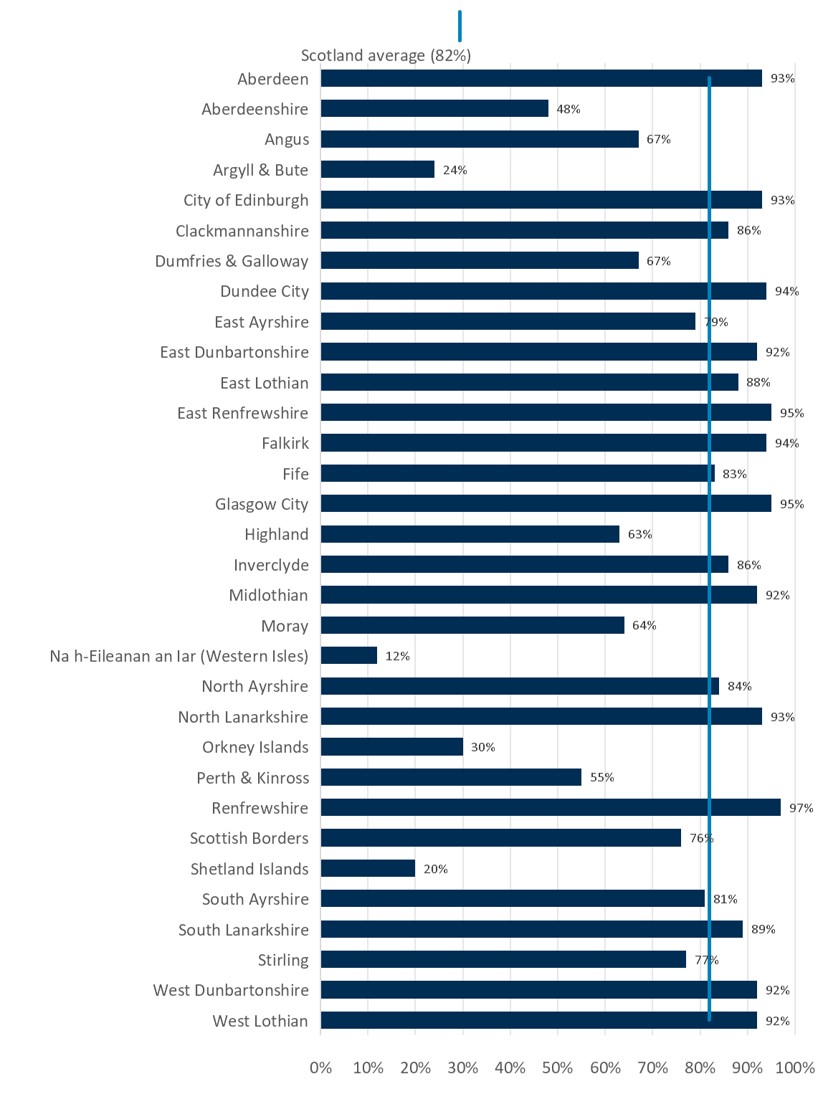
The proportion and distribution of the more than 500,000 premises in Scotland who do not have access to gigabit-capable broadband varies between each of the 32 local authorities of Scotland (Chart 3). In Aberdeenshire, Argyll & Bute, the Western Isles, the Orkney Islands and the Shetland Islands, less than half of all premises have access to gigabit-capable broadband. The local authority areas of Angus, Dumfries & Galloway, Highland, Moray and Perth & Kinross, also have lower proportions of premises with access to gigabit-capable broadband, at under 70%.
Chart 3: Gigabit-capable broadband coverage varies by local authority
Percentage of premises with access to gigabit-capable broadband, by local authority
Source: Ofcom: Connected Nations Data Downloads 2026: Fixed broadband coverage and take up
The UK Government and the Scottish Government have both invested in the roll-out of gigabit-capable broadband. In 2024 the UK Government committed £800 million toward achieving full gigabit coverage across Great Britain.[16] The UK Government’s Project Gigabit aims for 99% of premises to have access to a gigabit-capable connection by 2032.[17] The Scottish Government has committed £600 million investment as part of its Reaching 100% (R100) programme which aims to bring faster broadband, including gigabit-capable broadband, to hard-to-reach premises across Scotland.[18]
Ofcom is required to provide infrastructure reports, prepared under section 134A of the Communications Act 2003, which address future build proposals. The Secretary of State must have regard to these reports for three purposes:
- the allocation of public funds for the bringing into operation of electronic communications networks
- the design of national broadband plans
- verifying the availability of services to which universal service conditions apply[19]
The most recent report, based on the stated deployment plans of network operators over the next three years, was published in May 2026. The report outlines that full fibre could be made available to 28.1 million UK homes (92% of all residential properties) by the end of 2028, with gigabit coverage also increasing to 29 million homes (95%), up from 27.1 million (89%).[20]
When all operator plans are included, 96% of urban properties in Scotland could have gigabit coverage by January 2029, and 81% of rural properties. This remains the lowest predicted coverage level of the UK nations, with the comparable UK figures being 97% of urban properties and 86% of rural properties. Levels of full-fibre build are also forecast to remain the lowest of the UK nations.[21]
When looking at levels of competition, if all plans are included, Scotland is set to have 67% of properties covered by two or more gigabit operators, and 34% covered by three or more operators. This compares to UK figures of 73% and 36% respectively.[22]
Superfast broadband
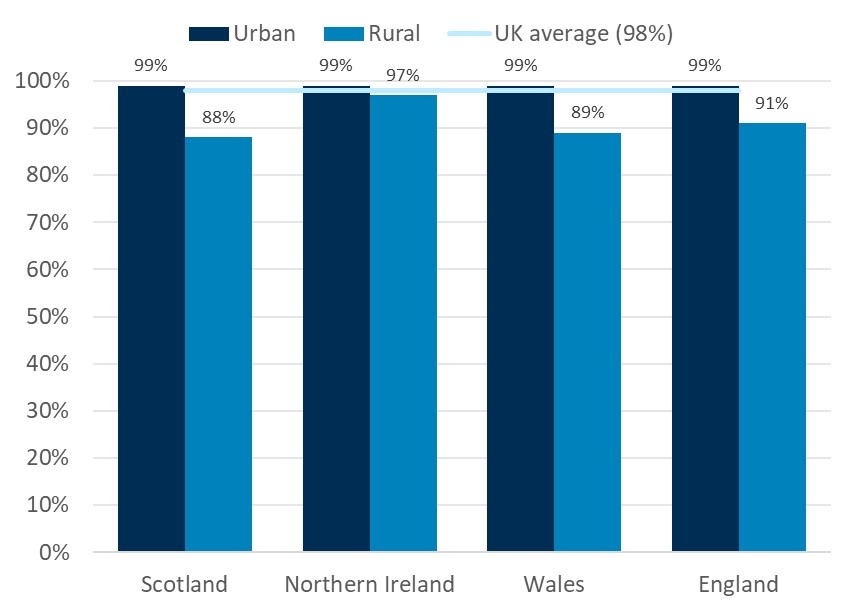
Superfast broadband offers download speeds of at least 30Mbps or above.[23] Across the UK, 98% of all premises now have access to this. In Scotland, the figure is 97%. However, there remains a disparity in access between urban and rural consumers. In Scotland, 88% of rural premises have access to Superfast broadband, compared with 99% of urban premises.
Chart 4: Superfast broadband is lower among rural premises
Percentage of premises with access to Superfast broadband, by UK nation and urban/rural location
Source: Ofcom Connected Nations Spring Update 2026
In 2025, the take-up of Superfast broadband services across the UK increased from 72% to 75%.[24] This means that the UK Government must now review the adequacy of the Universal Service Obligation for Broadband, as Section 72B of the Communications Act 2023 requires such a review once the take-up of Superfast reaches 75% across the UK. The review provides an opportunity to reconsider the connectivity needs of consumers across the nations. Although the trigger for this review was reached in 2025, the review has not yet taken place. The UK Government has recently set out its expectation that Ofcom will work with Government to review the USO and to agree and then make any appropriate changes. However, no timeframe has been placed on this review.[25]
The Broadband Universal Service Obligation
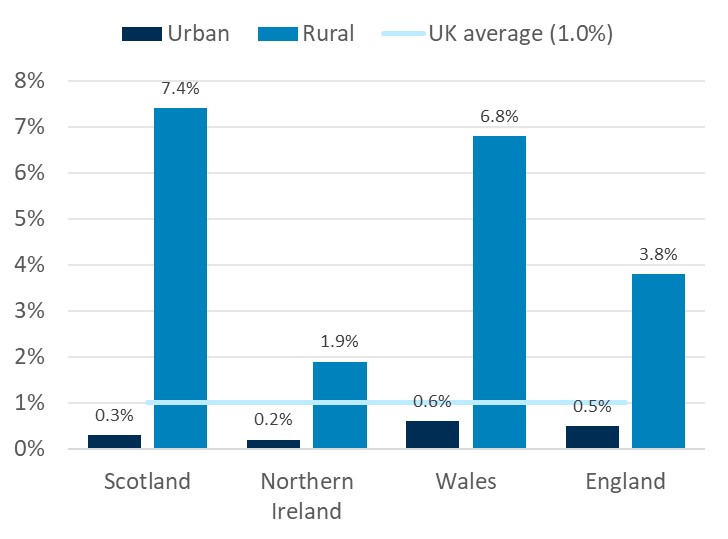
Ofcom estimates that across the UK, 1% of all premises, or 335,150 premises, are unable to access a fixed-line connection which can provide broadband with a download speed of at least 10 Mbps and upload speed of at least 1 Mbps.[26] Where a consumer is unable to receive affordable, “decent broadband” to their fixed-line connection, the Universal Service Obligation requires BT or KCOM (as the universal service providers) to provide this, where the costs of doing so are below £3,400. If the costs are in excess of £3,400, the consumer has the option of paying the difference to obtain a USO connection. Providers have so far helped to build a USO connection to over 9,000 premises.[27]
The proportion of consumers unable to access the minimum level of fixed line service across the UK nations is shown in Chart 5. In Scotland, 51,211 premises (2% of all premises) are unable to access this minimum broadband speed using a fixed line service. The majority (43,602, equivalent to 85%) of these premises are rural, meaning that 7% of rural premises are unable to access the minimum broadband speed.
Chart 5: In Scotland, 7% of rural premises are unable to access the minimum level of fixed line service
Percentage of premises unable to access USO standard broadband speeds via fixed line connections, by UK nation and urban/rural location
Source: Ofcom: Connected Nations Spring Update 2026: Fixed broadband coverage and take-up
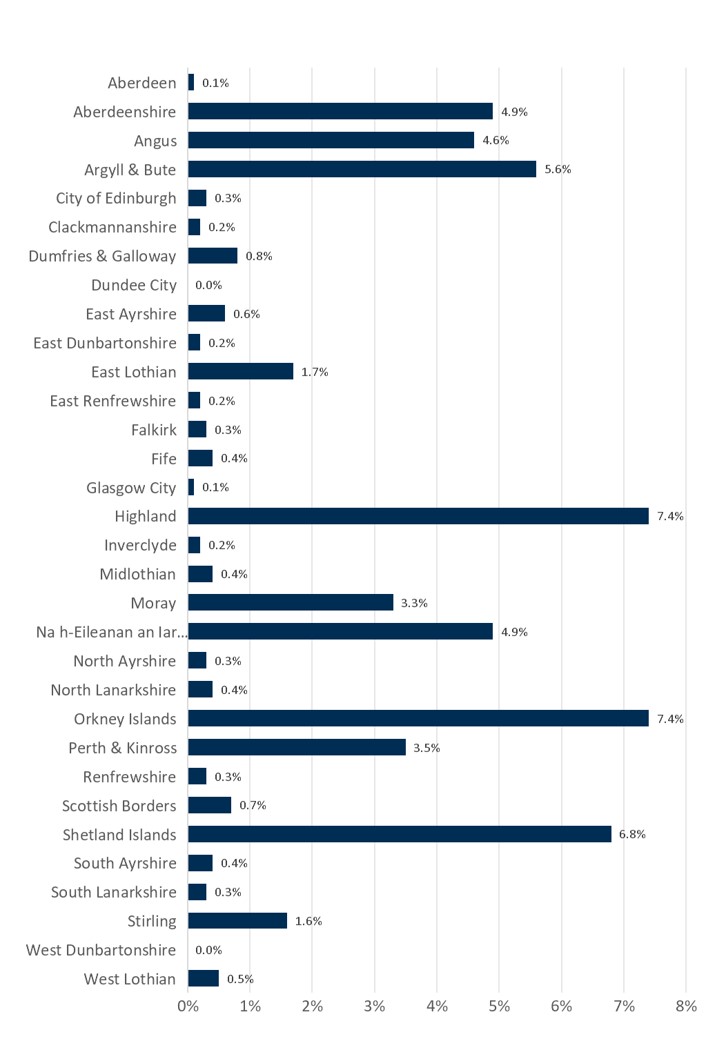
Further details of consumers in Scotland with no access to fixed line USO standard broadband, according to local authority area, are set out in Chart 6.
As with the gigabit coverage discussed above, it shows a similar pattern of local authorities where USO standard fixed-line broadband coverage is poorest. Around 5% or more of premises unable to receive 10Mbps are in Aberdeenshire, Angus, Argyll & Bute, Highland, the Western Isles, the Orkney Islands and the Shetland Islands.
Ofcom does not provide local authority figures for premises unable to receive the USO standard coverage by fixed line connection in the data tables accompanying the Connected Nations reports, instead providing figures for premises “unable to receive 10 Mbps”, and so the local authority figures are not directly comparable with the overall national figures provided above. This is because the local authority figure does not include “unmatched” premises. There are around 10,000 premises that are unable to be matched to any fixed line provider record with a non-zero predicted download speed.
Chart 6: Access to USO standard broadband coverage varies by local authority
Percentage of premises unable to receive 10Mbps, by local authority
Source: Ofcom: Connected Nations Data Downloads Spring 2026: Fixed broadband coverage and take-up
For those premises that do not have access to “decent broadband” via a fixed-line connection, a proportion are able to receive a connection that meets the USO standard via FWA or satellite connections.[28] Once FWA and Wireless ISP connections are factored in, the number of premises across the UK that do not have access to a decent broadband connection by any of these means falls to 39,072 premises. Ofcom estimates that 9,064 of these remaining premises are in Scotland.[29]
Ofcom notes that many premises currently without fixed or FWA broadband access will be connected via publicly funded schemes by January 2027. Ofcom estimates that the number of UK premises without a decent broadband connection from a fixed line or FWA could fall to around 36,000 by the end of 2026.[30]
The cost of connecting more than nine out of ten of the remaining premises who do not have access to decent broadband is likely to exceed the £3,400 threshold, with many quotes being unaffordable for consumers. Ofcom therefore expect the current broadband USO to play only a limited role in connecting the remaining premises. The most expensive premises to connect will require alternative solutions.[31]
It is worth noting the rapid increase in satellite broadband services in the UK. Once affordable satellite connectivity is layered onto these figures, Ofcom estimates that the number of UK premises without access to affordable decent broadband (the USO standard) by any means falls even further, to only 4,000 premises.[32]
In 2025, Starlink reported 110,000 active connections, with 12,600 of these connections in locations without access to decent broadband from a fixed line or FWA. In Scotland, Starlink had 15,000 subscribers in 2025 compared to 11,000 in 2024. Approximately 2,000 of these subscribers are without access to decent broadband through other means.[33] Amazon also has plans to offer direct to consumer broadband from 2026,[34] raising the likelihood of more effective competition and consumer choice in this market.
Overall assessment of broadband connectivity for consumers in Scotland
Despite rapid technological advances, it is clear that connectivity challenges remain for broadband consumers in Scotland. More than 9,000 premises in Scotland still cannot access “decent” affordable broadband speeds through fixed line or FWA connectivity. Additionally, 12% of premises in rural Scotland are unable to obtain Superfast broadband speeds and only 49% of rural consumers have access to gigabit-capable broadband, compared with 87% of urban consumers, the most significant gap in coverage of any of the four nations of the UK.[35] Given the extent to which telecommunications services are embedded into consumers daily lives, this raises issues around the ability of these consumers to access goods and services, including public services, which are increasingly delivered online.
While USO broadband speeds of 10 Mbps download should be stable enough to support video calls, downloading a one-hour HD TV episode (1 GB) would take almost 15 minutes. By contrast, Superfast broadband (30 Mbps) allows streaming of video services and downloading a one hour HD TV episode would take under four and a half minutes. It is also possible for several devices to work simultaneously using Superfast speeds.[36] Information from Project Gigabit notes that downloading a 4Gb High-Definition movie with a 1 Gbps FTTP connection would take 30 seconds compared to around 5 minutes with an ultrafast 100 Mbps FTTC connection and around 18 minutes with a Superfast 30 Mbps FTTC connection.[37]
There are arguments that the minimum connection speeds that fall within the “affordable, decent” definition of the Broadband USO should be updated to reflect more modern usage requirements of consumers. Increasing the speed of a “decent” USO broadband connection would reduce the risk that some consumers, predominantly in rural areas, are left with significantly poorer services.
There are also real challenges in promoting network investment in broadband services in sparsely populated areas. However, without that investment, consumers risk experiencing continuing detriment due to the gap in connectivity that exists for rural consumers. The Scottish Government’s National Islands Plan[38] recognises this risk and sets out a number of proposed actions. These include carrying out a mapping exercise to monitor broadband delivery, identifying gaps in gigabit-capable coverage, and informing discussions with providers, industry and the UK Government on future digital connectivity investments for islands. In addition, the Scottish Government aims to align delivery of the Scottish Government’s Reaching 100% (R100) contracts with Project Gigabit contracts to maximise island coverage. This includes Project Gigabit commitments to further extend gigabit-capable broadband coverage to over 13,000 eligible premises across the Northern Isles. The Scottish Government will also consider how emerging technologies might be used to boost mobile connectivity in the islands.
Work is ongoing in relation to a rural delivery plan for Scotland, so it is less clear what specific measures are under consideration for mainland rural areas, although the Scottish Government notes that there is ongoing work in relation to the Reaching 100% (R100) programme, the R100 Scottish Broadband Voucher Scheme (SBVS), the deployment of Project Gigabit funding and the prioritising of early investment in Scotland’s islands and across rural Scotland.[39] This work aims to build on the aspirations set out in Scotland's Full Fibre Charter[40], which is intended to support rollout of services in areas which might otherwise prove non-commercial. Improved rollout of these services is important in allowing consumers to have a choice of provider. Consumers would benefit from having a greater choice of infrastructure through which to receive services, and consequently a wider choice of provider. This allows them to switch operators, selecting services which meet their needs and giving them a stronger position when reaching the end of any fixed contract. It also enhances competition in the market encouraging providers to maintain healthy competition and facilitating competitive prices and added value services.
Consumer Scotland recommends that Ofcom and the UK Government should ensure that the Broadband USO review commences promptly in 2026. The review should:
- raise the speeds specified in the USO to at least Superfast levels, to support effective consumer confidence and participation across the economy and society
- take a “technology agnostic” approach to how the USO can be fulfilled, drawing on the possibilities offered by recent developments such as the rollout of satellite technology, improved FWA connectivity and standalone 5G and 6G mobile services
- ensure that affordability remains a key component of the USO criteria to ensure services are accessible to as many consumers as possible and to prevent detriment
Ofcom should continue to monitor access to any revised USO, reporting on coverage by nation, and local and constituency areas, and with coverage also broken down by rural and urban areas.
Consumers should have clear, easy to understand information about the technological solutions available to them now; and the timescales for other technology to reach them. We recommend that consumer facing coverage reports should be extended to outline clear targets for when various technologies are expected to be available to consumers, based on their postcodes. This information should allow consumers to understand what each speed can provide them, in everyday, accessible language, so that they can understand the trade-offs between speed and cost.
The Scottish Government should refresh Scotland’s Full Fibre Charter in the light of the revised USO obligation, and the planned network developments, clearly identifying the actions it will take to improve connectivity, whether alone or working with partners.
Mobile Connectivity
Scotland’s mobile telephone network largely consists of technology providing 4G and 5G services. 2G and 3G networks are being phased out. Most MNOs have now switched off 3G services and 2G services are scheduled to be retired by 2033.[41]
4G has the highest level of geographic coverage and continues to be the predominant technology for mobile telephone users in the UK, carrying 72% of all mobile traffic.[42] Ofcom estimates that mobile voice services from all four MNOs are available across 85% of the UK’s geographic area. However, across the UK there is a disparity between rural and urban inside premises voice coverage levels from all MNOs, with UK urban areas at 97%, compared to rural, which is at 70%.[43] This may mean that consumers in some rural areas struggle to make voice calls from within premises when relying on mobile networks. Consumers may be able to mitigate this risk by relying on calling using Wi-Fi networks where available. It is therefore likely to pose most difficulties for consumers reliant on mobile phones and who do not have access to Wi-Fi networks at home.
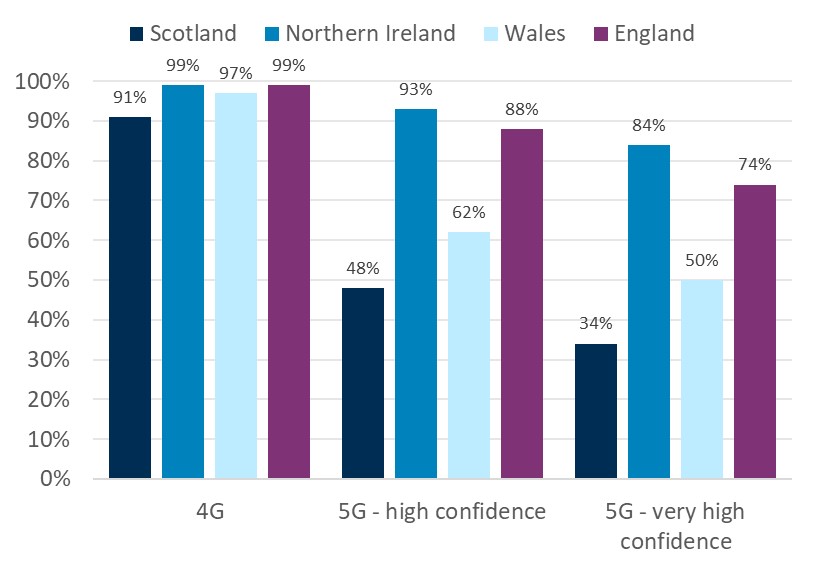
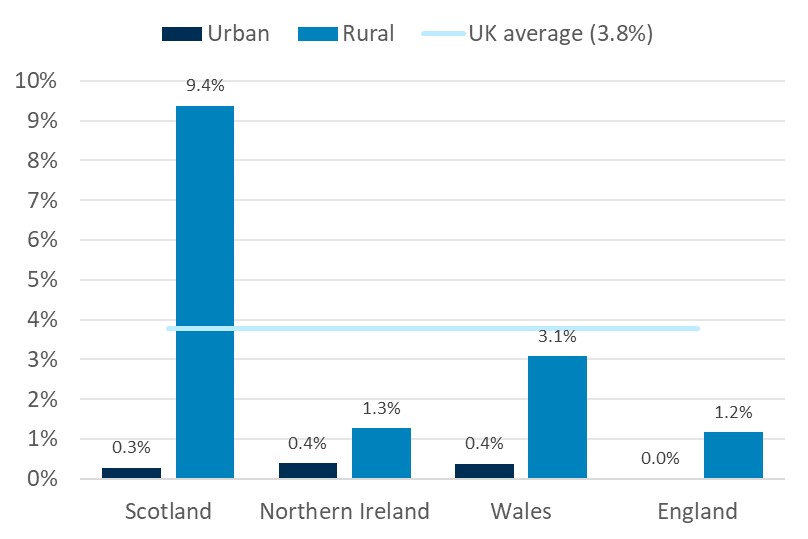
Scotland has the lowest 4G geographical coverage of all four nations of the UK, with 71% of its landmass area having coverage from all providers.[44] Scotland also suffers from the highest incidence of 4G total not-spots (landmass areas which do not receive mobile telephone coverage from any operator). Scotland’s landmass is 9% 4G not-spots, as compared with a UK average of 4%.[45]
Roll-out of the latest generation of 5G technology continues steadily but has yet to reach similar levels to that of the 4G network. 5G coverage is categorised according to two confidence levels, depending on signal strength, associated with an 80% or 95% probability of coverage. Just 48% of Scotland’s landmass has coverage from at least one MNO at the High Confidence level, compared to a UK figure of 73%. Scotland also has the lowest 5G geographic coverage range of all four UK nations.[46]
Poor connectivity or mobile network performance can have a range of impacts on consumers. Mobile networks enable people to stay in touch with family, friends and colleagues, manage travel and navigation, access entertainment, and carry out everyday tasks such as banking, shopping and ticketing. In turn, this supports both economic participation and social inclusion. Poor or unreliable connectivity make it more difficult to check on family members, access services, run a business or carry out work tasks, causing disruption and anxiety.[47]
Chart 7: Scotland has substantially lower 5G geographic coverage than other UK nations
Percentage of geographic mobile coverage from at least one provider, by technology and UK nation
Source: Connected Nations Spring Update 2026
Chart 8: Rural Scotland has particularly high levels of 4G not spots
Percentage of 4G ‘not spots’ (geographic mobile coverage from no provider), by UK nation and urban/rural location
Source: Connected Nations Spring Update 2026
In March 2020, the UK Government entered into an agreement with MNOs called the Shared Rural Network. This aims to extend 4G coverage to 95% of UK geographical areas by the end of 2025 and to take action to address 4G not-spots.[48]140 masts have been activated using UK Government funding, with 50 of these in Scotland. It was announced in June 2025 that this 95% coverage target had been achieved one-year ahead of schedule.[49] The project is ongoing, and it is anticipated that all remaining planned builds of new not-spot telephone masts will be completed by the end of 2026.[50]
The Scottish Government has also invested £28.75 million in a programme to address not-spots, called the Scottish 4G Infill Programme (S4GI), which has been completed.[51]
In June 2025, the Department for Science, Innovation and Technology (DSIT) amended the Shared Rural Network agreement[52] to reduce the number of total not-spot telephone masts planned to be built from over 300 to 44, following spending concerns raised by the National Audit Office.[53]
In oral evidence to the Public Accounts Committee (PAC) on 22 April 2024, the then-permanent secretary of DSIT, Sarah Munby, commented that:
“The 5% that is left at the end is what you might call extremely rural areas… This is extremely remote areas of the highlands-type areas, right?... On the question of whether you should extend into that very last 5%, do not get me wrong: if you are one of the small number of people who live in that last 5%, that is a hard question. But the business case by that point… starts to fall fundamentally off a cliff.”[54]
The UK Government has stated that it is not possible to predict which parts of the UK will remain without 4G coverage, following completion of the Shared Rural Network programme, because final locations of proposed new total not-spot masts have yet to be determined. However, DSIT has noted that while a small percentage of the UK’s landmass will remain uncovered, 99% of UK premises already have indoor access to at least one mobile network operator’s 4G network, meaning that very few premises across the UK will lack connectivity by the end of the programme.[55]
In relation to 5G, the UK Government’s current target is for all populated areas to have access to standalone 5G coverage by 2030. However, the costs of deploying advanced networks remain high, with industry estimating costs of up to £34 billion for the deployment of advanced 5G to 2030.[56] The UK Government is currently conducting a Mobile Market Review which aims to consider barriers to the further development of the sector and assess how industry can be best supported to deliver the necessary investments while meeting the needs of consumers.[57]
Evidence to the PAC from other stakeholders noted that even following the installation of new masts, existing coverage did not always reach consumer expectations. The PAC concluded that the mobile coverage data reported by Ofcom did not always reflect the actual level of service that businesses and consumers experience, which may sometimes be significantly worse than reported. It recommended urgent action to address this, including
- Asking Ofcom to examine any cases where areas have lost all mobile connectivity following 3G switch off
- Ensuring that mechanisms for measuring access to 5G coverage are fit for purpose.[58]
Consumer Scotland supports these recommendations. The UK Government has subsequently directed Ofcom to further develop its coverage reporting of 4G and 5G networks to help track progress of the rollout. Specifically, Ofcom has been asked to improve reporting on mobile network availability and quality, reviewing the definition of “good” coverage and the means by which this is measured. The aim is that this better reflects consumer expectations as user requirements and behaviours continue to evolve. Ofcom has also been asked to ensure that consumer facing information on coverage and performance is provided in user friendly and easy to-understand ways.
The UK Government has also asked that Ofcom continues to report via Connected Nations on coverage by local authority, combined authority and constituency basis. Ofcom will also update the way it reports on standalone 5G and provide data on coverage and performance across the UK’s road and rail infrastructure in its reporting.[59] Consumer Scotland welcomes these measures which should help to provide consumers with better information about which services will meet their needs.[60]
Ofcom recently issued a discussion paper regarding mobile connectivity, noting that while there has been considerable effort on expanding coverage, this alone is not enough. Consumers need good, reliable connections which will support the apps and services they use, requiring networks to provide a strong enough signal and sufficient capacity to keep connections working well. Ofcom proposes new metrics, based on international comparators, to measure connectivity, along with benchmarking assessing how often good performance is achieved. These measures will be supplemented by the improvements already noted to their coverage checkers. They also note that improvements to mobile connectivity, and linked work to improve mobile network resilience, will depend on action by government, local authorities, landlords, developers, estate managers, MNOs and other infrastructure providers.
As with broadband connectivity there is a notable gap between urban and rural coverage. As part of work to improve coverage and quality information, Ofcom has examined mobile coverage and performance across areas with different levels of rurality and found that performance was highest in large cities (83%) and declines steadily as areas become more rural, reaching its lowest levels in accessible and remote rural areas (71%). These issues can be caused by capacity issues, coverage issues or a combination of both factors. In a recent discussion paper, Ofcom recognises that
"The infrastructure to provide reliable, seamless mobile connectivity is unlikely to be consistently available in more remote areas due to the technical and commercial challenges involved. Achieving the standard which we have defined as good performance may not be realistic in areas which are not frequented by many people. Nevertheless, it may still be important to ensure coverage supporting a more basic set of services in such areas."[61]
While there have been considerable advances in connectivity through investments by both providers and the UK and Scottish Governments, both 4G and 5G coverage in Scotland continue to lag behind UK figures. As noted above, mobile network performance also remains less good in rural areas, disproportionately affecting consumers in Scotland given our distinctive geography. It is important that consumers in Scotland can depend on reliable services that provide appropriate and equitable coverage and performance of the areas in which they live, work and undertake leisure activities. Ofcom is planning to assess performance using crowdsourced data to understand how often the proposed metric is achieved in real‑world use. Consumer Scotland supports these measures but notes that it will be important to ensure that this crowdsourced data is obtained from a full range of geographic areas in order to understand where poorer than average performance may affect consumer experiences. We recommend that Ofcom monitors this performance and explicitly uses the data received to drive discussions with governments and operators about future network deployments and to target funding towards areas where performance is poor but where remedial actions may be commercially unviable for providers.
Consumer Scotland welcomes Ofcom’s recent reports on mobile network performance and planned network deployment. Due to the commercially sensitive nature of the data, the published planned network deployment report contains only UK-level findings, together with aggregated and anonymised information on planned deployment for each of the UK nations and local authorities. The Secretary of State is also supplied with additional data on specific operator and property coverage to support decision making.
We recommend that following on from Ofcom’s report on planned network deployments, and the conclusion of the Mobile Markets Review, Ofcom and the UK and Scottish Governments should work together to identify and agree priority areas for further investment both by providers and governments. In addition to its proposed 90% good performance UK coverage benchmark, nations-level benchmarks should be set to ensure the delivery of performance improvement across Scotland and the other UK nations.
Improvements have been made, or proposed, to the monitoring and reporting of coverage and performance. With these measures in place, it should now be easier to see the areas in which coverage is lacking or performance is poor. What is less clear, as existing government support packages reach completion, is how future investment decisions will be reached, and how any future funding can be delivered in a way that reduces duplication, maximises impact and works to close the gap between urban and rural services. There is a risk that urban services continue to improve where commercial factors make network upgrades financially attractive for providers but that rural services stagnate once (relatively low) minimum standards of connectivity have been reached or where services are in place from only one provider. Ofcom should work with UK and devolved governments to ensure that action is taken to address this urban/rural gap and to support improved performance and improved consumer choice.
Investment decisions should draw on the possibilities offered by new technologies such as 5G standalone services, 6G or direct to device satellite calling to identify the most cost-effective solutions for “hard to reach” areas.
As well as being attractive to providers, these solutions must also be affordable for consumers. The information available to consumers should also outline more clearly the target date for rollout of various technologies by postcode. This information should draw together work by providers and by both governments to provide a more comprehensive picture than currently exists, expressed in more user-friendly ways.
Technology and Network resilience issues
2G and 3G Mobile Services
A number of changes are taking place in Scotland’s telecommunications infrastructure. As noted above, 2G and 3G networks are being phased out, with most MNOs having switched off 3G services and 2G services scheduled to be retired by 2033. Retiring these services, which utilise older technology, allows more bandwidth to be allocated to 4G and 5G networks. This also allows operators to make savings from having to maintain fewer networks, potentially releasing funds for future network investments.
These changes are provider-led, meaning that different operators will make changes to their services at different times. Some providers will retire 2G services earlier than others or begin to restrict or move traffic away from the 2G network. In order to continue to receive services, consumers will need to have a device that is capable of operating on networks running 4G services or above. For some consumers, this may simply require a change to device software or settings, while others will need to upgrade their device. Ofcom expects providers to contact consumers to provide advice on what they need to do. Some consumers may also have ancillary or “Internet of Things” devices such as care or security alarms or payment terminals linked to devices and they will need to check compatibility of these with their device provider.[62] Consumers may also need to safely dispose of or recycle obsolete devices.
The phase-out of 2G has particular implications for the operability of the communications hubs for first-generation energy smart meters. While the regulator, the Data Communications Company, and energy suppliers are well aware of this issue and should be putting in place plans to replace or upgrade communications hubs, we would urge continued close communication between Ofgem and Ofcom to ensure any negative implications for energy consumers are mitigated ahead of time. This is particularly important as many time-of-use and flexible tariffs rely on a properly functioning smart meter - if the meter can no longer operate in smart mode this could lead to energy customers paying more than they expect to.
In early 2026 the UK’s MNOs and the UK Government agreed a set of commitments in the form of a Charter to ensure that the 2G switch-off takes place safely, with access to critical national services and vulnerable consumers protected. However, in many cases operators do not have a direct customer relationship with consumers, as consumers may purchase services from an MVNO who does not operate the underlying network. The Charter notes that 2G network users must also take responsibility for identifying any impacts to their service(s) and take appropriate steps to maintain connectivity. Key commitments covered in the Charter include setting out the timetables and methods for MNO and MVNOs to communicate changes to consumers, along with a requirement to verify that 4G or 5G coverage exists before switch-off to avoid creating any new not-spots.[63]
Consumer Scotland considers that it is unrealistic to expect consumers to be aware of these changes and that it may be challenging for providers to contact consumers directly. We recommend that, in the lead up to the 2G switch-off, Ofcom undertakes active monitoring of consumer awareness of the changes and sets out what it considers an adequate awareness level of these changes, among affected consumers, would be. Where awareness levels are below this, this should trigger further, Government backed, communication measures both directly to consumers and through trusted intermediaries to raise awareness, as has been the case with digital calling.
Digital Voice
Changes are also occurring to the landline (fixed-line) network. These changes are necessary as the existing technology (the Public Switched Telephone Network or PSTN) is operating beyond its intended lifespan and becoming increasingly unreliable.[64] The PSTN is due to be switched off by the end of January 2027.[65] Consumers who currently take a landline service are being migrated to a service provided via broadband, using Voice Over Internet Protocol (VoIP) technology, often referred to as “digital voice”. As with the 2G and 3G switch-off, the change is industry-led and the decisions regarding retirement of the PSTN lie with providers. This means that the migration is undertaken by different companies, at different times, and may involve different equipment or terminology depending on their plans.
This migration is now well underway and PSTN connections now account for less than one fifth of residential landline connections (19%). Around 3.2 million residential landline customers were estimated to still use the PSTN as of July 2025, with 4.2 million using “emulated PSTN”, which has similar features but does not rely on its outdated technology.[66] In July 2026, Ofcom estimated the toral number of PSTN customers had fallen to around 1.5 million.[67]
Industry had originally planned 31 December 2025 as the deadline for the PSTN switch-off, but migration has been paused twice, first by BT in 2022,[68] and then by the UK Government in 2023, when it became apparent that some consumers were at risk of serious harm due to their telecare devices being disconnected during the migration. An Ofcom investigation found that Virgin Media had failed to properly identify and record the status of some telecare consumers, resulting in affected consumers not being provided with the appropriate level of tailored support through the migration process. Ofcom found that the processes used had put thousands of vulnerable consumers at a direct risk of harm and prevented their devices from connecting to alarm monitoring centres.[69]
Consumer Scotland analysis has found that a significant minority of consumers are potentially vulnerable as a result of the migration.[70] A key concern is that proportionately more consumers in rural areas of Scotland could be at risk of harm as they might be unable to make an emergency phone call, or contact friends and family, in the event of a power-cut.[71] This is because digital calling services are reliant on a home power supply. The risks are greater for consumers in rural areas of Scotland due to a combination of more frequent and longer lasting power cuts, a greater reliance on use of landlines and poorer mobile coverage and signal quality. In addition, there are specific risks posed for consumers who rely on connected devices, in particular for those who rely on health devices such as telecare alarms.[72] Previous Consumer Scotland work highlighted that the one-hour minimum battery back-up proposed by Ofcom for digital landlines and telephone mast sites may not meet the need of consumers in Scotland because of these factors. We have recommended measures to increase consumer understanding of the changes through a public information campaign and measures to improve monitoring and reporting regarding the resilience of communications networks.[73]
The UK Government has acted to address the concerns raised by Consumer Scotland and others, and the evidence of risks to consumers, by entering into a Charter with communications providers and network operators. This set out the steps that communications providers and network operators were expected to take to support consumers who might be vulnerable or require additional support during the migration.[74] Telecare usage, landline dependency and a lack of access to mobile devices or connectivity are all factors which providers are asked to take steps to identify and which might indicate that a consumer requires a “supported journey”. Consumers are also able to contact providers to self-identify as requiring support with migration. A public information campaign, aimed at telecare users and those who support them, has been undertaken.
In March 2026, the UK Government also entered into a number of further Charters with providers, network operators and wholesalers. These set out the timeframes and methods for communicating with consumers, the steps which providers must take to identify consumers needing support, and the safeguards which should be put in place to ensure consumers still receive access to services during migration. Notably, any known telecare users will not be migrated until providers or operators can confirm that a compatible and functioning telecare solution is in place. Industry has also committed to work to provide backup solutions that go beyond the Ofcom minimum of one hour of continued, uninterrupted access to emergency services in the event of a power outage.[75]
These are welcome measures. However, the overall resilience of the telecommunications network in the event of a power cut remains a concern for consumers in Scotland, who are at higher risk of harm given the greater number and duration of power cuts here. These power cuts can affect not only digital voice landline services, but also mobile sites which are reliant on power or may have limited power backup. This potentially leaves customers at risk of being unable to make either landline or mobile calls during power cuts.
During recent storms such as Darwen, Eowyn, Floris and Amy, some customers were without power for a number of days. In some instances mobile sites were also affected. This poses a cascading risk for consumers where multiple services are impacted. Ofgem analysis of network data shows that following storms, 85% of customers are reconnected within eight hours, and 98% of customers are restored within 25 hours.[76] These time periods are well outside the prescribed battery back-up talk time of one hour, or even the four hours that some providers have committed to.
Stakeholder engagement has highlighted that a number of misconceptions remain around the implications of the migration to digital voice with only a few months remaining before the switchoff date. The migration process has highlighted the importance of clear and consistent communication from telecommunications providers regarding this and future transition processes, the technologies that can support Digital Voice services, and the measures available to maintain access to communications during power interruptions for consumers in vulnerable circumstances.
In addition, consumers who previously did not possess characteristics putting them at higher risk may develop these following migration. Moving house may place consumers in an area with poorer mobile signal, they may develop illnesses, acquire caring responsibilities or other situational vulnerabilities. It is not clear how providers will ensure that their records remain up to date following the migration process. Many consumers may not be aware that they need to contact their provider to ensure that they have back-up equipment in place. In addition to back-up equipment required in consumers’ own premises, access to services can also be impacted by network resilience issues. Action is required to tackle these issues.
Security and Resilience Concerns
Ofcom published its Network and Service Resilience Guidance for Communications Providers on 6 September 2024.[77] This followed an earlier consultation on a proposal that mobile phone cabinets should have adequate power backup to allow services to be maintained for at least four hours in the event of power outages.[78] The proposal was removed from the published guidance, following concerns raised by communications providers about the costs of providing power back-up to existing cabinets, with Ofcom noting that they could not be sure this requirement was proportionate.[79]
Instead, Ofcom stated that power backup with a planned capacity of three or four hours would be considered to be good practice for active fixed access cabinets that are new installations.[80] Ofcom also committed to undertaking further work to review mobile network resilience.[81] While recognising the costs involved in retrofitting existing infrastructure, Consumer Scotland considers that this decision does not adequately take into account the cumulative risks to consumers of the 2G and 3G switch off and the move to digital calling, which may leave consumers in rural areas at risk of extended periods where they may not be able to communicate with friends, colleagues or emergency or support services. We would welcome Ofcom bringing forward this additional work promptly.
More recently, the UK Government has provided further guidance to Ofcom on its approach to resilience issues. Noting the cross-sectoral challenges in ensuring power resilience, it encouraged Ofcom to conclude its current review into mobile power resilience as soon as possible, to consider the available data and to suggest proportionate and appropriate measures to achieve resilience in the mobile access network. The government has indicated that it expects Ofcom to work with communications providers, government and the power sector to implement measures that reduce power cuts and service loss and mitigate the impact of service loss for consumers. The UK Government has also stated that it would welcome Ofcom reviewing how power outages affect fixed voice and broadband networks in the UK to ensure there is an up-to-date and holistic approach across the whole network.[82]
The expectations set by the UK Government about the roles of Ofcom and industry in relation to the migration to digital calling and overall network resilience have the potential to benefit consumers. While the approach to resilience issues must be reasonable and proportionate, the telecommunications network has a fundamental role to play in ensuring that consumers can contact critical public services, friends, family and wider support. It also allows consumers to access information during adverse weather or other civil emergencies. Any resilience regime must secure the ability of consumers to do that. It must also respond to climatic and geographical realities, which mean that undertaking repairs to physical infrastructure may not be quick or straightforward. It must also recognise the interplay different communications technologies and the compounded risk that can be presented when multiple technologies are affected by resilience or network security incidents.
We recommend that Ofcom sets out a detailed timetable for concluding its engagement with providers and power distribution networks to assess which sites are most at risk of continuing outages. Following this, Ofcom should set out a plan of action, by the end of 2026, to ensure that the effects of outages on consumers can be reduced. Actions might include updating infrastructure to allow better monitoring or easier repair or considering what role satellite services might play in overall resilience. Where sites do not have backhaul or appropriate battery backup capability then upgrading of existing infrastructure should be considered. In particular, rural sites - where there is less overall resilience and where physical access to effect repairs during adverse weather can be challenging - may require additional resilience measures.
Consumers in more remote communities may wish to compare the contingency plans providers have in place for outages when joining or switching, but very limited information is currently publicly available. In the case of island communities served by subsea cables for example, providers may have arrangements for backup provision via the use of alternative routes during outages, but this information is rarely presented to the consumer until an outage occurs. These consumers may benefit from more meaningful, accessible information being available on resilience when they are comparing providers. We would welcome further consideration being given to the appropriate mechanisms by which this might be achieved.
In the case of service outages, Ofcom’s Automatic Compensation Scheme has set out to remove the need for consumers to raise a formal complaint to receive compensation. The scheme is voluntary however and not all providers take part, so application of compensation varies considerably between providers. In most cases consumers are expected to proactively contact their provider to report a fault in order to be eligible, including in cases where widespread outages affect an entire local area, such as an island. In these cases, there would be value in providers examining opportunities to provide automatic payments, where they are aware of multiple outages within their network in a specific geographic area, to reduce the burden and barriers for consumers in receiving compensation.
There is also more work to be done to identify and support telecommunications consumers in vulnerable circumstances or at risk of harm, whether through changes to legacy technology or other provider practices. A recent review of services which aim to support vulnerable consumers, conducted by a range of vulnerability experts for the Money Advice Trust, found that more than 20 schemes exist providing ways for consumers to tell service providers about their circumstances. These cover services from energy to education, and circumstances from death to direct debits, resulting in a fragmented and unconnected landscape of initiatives. The review recommended an increased focus on improved data sharing - controlled by users - between existing schemes.[83]
Existing Ofcom guidance to providers on treating vulnerable consumers fairly was developed in 2019 and updated in 2022. Since this time, cost of living pressures on consumers have intensified and considerable changes have taken place in how communication services are delivered. Other factors, such as low financial literacy or individual health characteristics which may contribute to individual consumer vulnerability are unlikely to have abated. We recommend that Ofcom urgently refresh its guidance on supporting consumers in vulnerable circumstances. This should build on the Charters developed by the UK Government, and incorporate learning from similar strategies in other sectors, such as Ofgem’s vulnerability strategy refresh and the Financial Conduct Authority’s Consumer Duty. It should set out protocols in relation to provider practices on issues such as pricing and contractual terms and debt recovery and forbearance practices. It should clearly set out Ofcom’s approach to how consumers can be supported to share relevant information about their needs with providers and describe Ofcom’s expectations of how providers will respond to these disclosures.
5. Consumer issues in the retail market
Consumer protection
This chapter assesses the impact of advances in technology and the effect of competition between providers on consumers. It addresses switching, as well as discussing issues around transparency of pricing and the adequacy of information provided to consumers. It also considers common causes of complaints and how well these are addressed.
Ofcom can set conditions “protecting the interests of the end-users of public electronic communications services” and these are generally implemented and enforced through the General Conditions of Entitlement for providers. These set out consumer protections in relation to contract requirements, information and transparency, billing, complaints, measures to meet the needs of vulnerable consumers, switching, sales and marketing. In addition, providers must comply with the provisions of the Digital Markets, Competition and Consumers Act 2024, which sets out a number of unfair or misleading practices which should be avoided, as well as creating new protections in relation to drip-pricing, subscription traps and fake reviews.
The UK Government has entered into a Telecoms Consumer Charter with a number of providers, as part of a commitment to ensuring that “all consumers feel confident, informed and empowered when engaging with the telecoms market”. The Charter aims to embed transparency, support consumers in financial difficulty and strengthen trust. Not all providers have signed up to this Charter and it should be noted that any Charter measures building further on Ofcom’s rules are voluntary in nature.
While a detailed analysis of how the retail market operates is beyond the scope of this report, we use the following sections to highlight issues where the retail market can pose challenges for consumers and where intervention may be needed to help consumers get better outcomes.
Consumer Engagement – Switching and Getting the Best Deal
Consumers have a variety of choices when paying for services. When it comes to mobile services, they can choose to pay monthly via a fixed term contract, to pay “as you go”, to bundle handset and SIM costs or to pay for SIM only services, with various bundles of calls and data.
Fixed line services can be for broadband or landline only and can also be bundled with related streaming and television services.
Fixed-term contracts for mobile telephone and fixed-line broadband connections are the most common way to pay for telecommunication services, with UK-wide research for Citizens Advice finding that 70% of UK adults pay for telecommunications services this way.[84]
Citizens Advice found that, of those consumers who enter a fixed-term contract, almost half (48%) tried to negotiate a new contract with the same provider at the end of their contract term. Less than a third (28%) choose to switch provider when their contract ends, while a quarter (26%) are out of term on their contract. Less than a fifth (18%) take out a new contract with their existing provider without negotiating.[85]
With advances in technology, and increased competition in the broadband market from altnets, Ofcom found that average broadband prices fell in real terms last year by an average of 6%. Consumers may now be able to switch to faster, more reliable full-fibre broadband product for the same - or a lower - price than they previously paid for a copper or part-fibre service. Ofcom found that 28% of broadband customers are out of contract and, on average, in contract customers spend between £7 and £9 a month less than out-of-contract customers.[86]
Mobile airtime prices are also continuing to fall; SIM only consumers on unlimited data contracts saw costs drop by 8% in real terms last year.[87] In general, consumers are getting more for their money with Ofcom research showing that between 2020 and 2025, the price of an average-use basket of mobile services fell by 20% in real terms, despite average data use more than doubling.[88]
In order to get a deal that meets their needs, consumers need to know that they are out of contract and can get a better deal from switching or from reconfiguring the services that they take (for example from bundling services or moving to a SIM only contract once a handset is paid off).
Consumers also need to be able to negotiate the switching process. Consumers can find the process of switching difficult, and provider behaviours can contribute to this. Ofcom recently fined Virgin Media £28M for systemic failures in dealing with telephone calls from consumers who wished to cancel their contracts between 1 January 2022 to 11 September 2024. Ofcom found that Virgin Media had engaged in deliberate call-dropping tactics, excessive and unnecessary call transfers and putting customers repeatedly on hold for no reason, leading to consumers being prevented or delayed in accessing better deals.[89]
In recent years, Ofcom have put in place measures to protect consumers and to make it easier for them to access deals. For example, mobile handsets can no longer be sold “locked” to a particular network. Providers must notify consumers when they are out of contract and let them know the best deals available via end of contract notifications (ECN). Where a consumer remains with a provider but is out of contract they must also remind them of this and let them know about the best deals through an annual best tariff notification (ABTN).[90] Ofcom has also developed coverage checkers to allow consumers to check provider coverage in their area when deciding whether to switch. As noted elsewhere in this report, Ofcom continues to work to present coverage and performance information in a more consumer friendly way and to improve the accuracy of this data.
Changes have also been made to the switching regime to make it easier for consumers to switch using the “One Touch Switch” service for broadband and “AutoSwitch” for mobile. These changes mean that consumers no longer need to contact their old providers to let them know they wish to cancel, a requirement which had led to the issues outlined above in relation to Virgin Media. An increased choice of providers, a wider range of deals and measures to improve the switching process have all contributed to rises in switching behaviours.
Following these reforms, Ofcom research found that around a quarter of households changed provider for at least one communications service last year. However, it also found that switching rates are lower for older consumers and those in lower socio-economic groups, who may feel less confident in comparing deals.[91]
Mobile Pricing Practices
Ofcom announced a ban on inflation-linked mid-contract price rises in new mobile phone contracts entered into from January 2025. This followed a rise in complaints to Ofcom as consumers experienced large and unexpected price rises due to strong underlying inflationary pressures in the economy.[92] Ofcom research found that more than half of pay monthly mobile customers and broadband customers did not know what inflation indexes such as the Consumer Price Index (CPI) and Retail Price Index (RPI) measure, and often found it difficult to estimate what the impact of these measures might be on their own contract prices.[93]
Under the new rules any price-rise written into a telecommunication customer’s contract must be expressed in pounds and pence (£/p) and be set out prominently and transparently, at the point of sale.[94] Despite these attempts to provide more contractual certainty, and enable consumers to plan and manage their budgets, some consumers have still experienced significant mid-contract price increases under the new regime.
For example, O2 imposed a mid-contract price increase which was specified in pounds and pence (£2.50 per month on their mobile contracts, a 40% increase in the contract price) which was criticised by both Ofcom and other stakeholders.[95] The UK Government asked Ofcom to revisit its rules in light of O2’s higher than expected price increase.[96] The Telecoms Consumer Charter sets out a clear commitment to the new pricing model and limits mid contract price increases in fixed term contracts to circumstances where unforeseeable and externally driven events materially affect the cost of providing services. It also set out arrangements for out of contract “legacy” consumers to move to this new pricing model.[97]
Reflecting how the telecommunications market works, Ofcom has committed to undertaking a full analysis of the impact of the new rules in 2026-27,[98] as part of ongoing work to help consumers have access to affordable mobile services. Consumer Scotland supports work to conduct prompt monitoring and evaluation of the new measures given ongoing cost of living pressures on consumers. Following this analysis, Ofcom should publish its approach to how it will ensure that pricing policies can best balance the need for a fair commercial return for providers with consumer needs for affordable, transparent and fairly delivered services. It is critical that consumers understand how much their services will cost for the entire duration of their contract so that they can appropriately budget for current and future costs.
Transparency
Given that fixed-term contracts are the primary purchase method, it is important that contract terms are fair and transparent and that consumers understand important contract elements, such as duration and price.
Citizens Advice have undertaken UK-wide research looking at factors which can prevent consumers from getting the best deals when re-contracting at the end of their fixed-term contracts. They noted that many consumers found negotiations difficult or stressful, especially where consumers were experiencing mental health problems, had cognitive or neurological disabilities or were in financial hardship. They found a lack of transparency in the process due to “asymmetric information” in three key areas:[99]
- Consumers don’t know about all the tariffs their provider can offer
- Consumers don’t know how much other consumers are paying for the same services
- A consumer’s current provider knows more about their usage and spend than competitor providers and so can offer more tailored deals
As a result, Citizens Advice has proposed changes to address these challenges and to reduce the need for consumers to contact their provider to access the best deals, including requiring providers to provide more information to consumers about their usage and to make any “best deal” offers clearer. Citizens Advice also wish to see “open data” schemes developed and more information published on current prices. [100]
The UK Government has recently directed Ofcom to assess the potential merits, and costs and benefits, of establishing a Smart Data scheme in telecoms, including examining whether this can be achieved on a voluntary basis.[101]
Consumer Scotland supports proportionate measures to ensure that consumers understand what they need from telecommunications services. We support the recommendation from Citizens Advice that providers should inform consumers of their annual or monthly usage. This can support consumers to identify which tariff works best for their needs and such information is routinely provided in other sectors such as energy, via monthly bills. In addition to usage, it would be helpful for consumers to understand what different speeds and packages offer in a more user-friendly way. What usage would a 10GB data package allow for example or how long would it take to download a podcast or streamed movie using the advertised speed? Information that allows consumers to move beyond abstract numbers and understand what they can do with each package would support improved decision-making.
Consumers should be able to access available deals using a variety of communication channels. Having to rely on calling an existing provider to negotiate and to access deals is something that will not work for every consumer, especially consumers in vulnerable circumstances. Providers should be required to give consumers clearer information about their usage and the best available deal across a wider range of communication channels, including any app or website accounts, to ensure the contractual process better meets consumer needs.
Even with this additional information provided, consumers who are less confident in negotiating, or who have cognitive impairments or other disabilities that make it difficult for them to access services such as switching sites, may find it hard to get the best deal. They are likely to be reliant on friends and family negotiating for them and providers may refuse to speak to supporters who are not named account holders. This may lead to the higher proportion of consumers in vulnerable circumstances being left on legacy deals or out of contract pricing. Ofcom should consider whether there is a case for developing assisted digital services that would facilitate engagement in switching and contract negotiation for consumers who would otherwise struggle to do this themselves.
Quality of Service and Detriment
Telecommunications services play an ever-increasing role in helping consumers access goods and services. Given this role in helping consumers access other goods and services, telecommunications services must be of appropriate quality. There must be ways for consumers to raise issues when things go wrong or where they are dissatisfied with services.
Ofcom can enforce consumer law on behalf of consumers but does not have the power to resolve individual consumer complaints about telecoms or postal services. Where appropriate, Ofcom can provide advice to consumers and refer them to Alternative Dispute Resolution schemes that Ofcom has approved.
Ofcom undertakes some thematic analysis of complaints data in its quarterly telecommunications sector complaints report.[102] Ofcom categorises complaints by consumers across 3 areas:
- Faults, service and provisioning (including technical issues)
- Complaints handling
- Billing, pricing and charges
“Technical issues” can include issues with broadband download/upload speeds or frequent drops or disconnections in service. Other technical issues raised include poor network coverage and reception. Complaints handling encompasses long wait-times to speak with customer service agents, and the use of chat bots.
For fixed-line services, the most significant driver of complaints is technical faults, service and provisioning, with the industry average rate at six complaints per 100,000 customers for fixed-line broadband and three complaints per 100,000 customers for fixed-line telephone or landline services.[103]
For pay monthly mobile complaints rates ran at two complaints per 100,000 customers and for pay TV they ran at two complaints per 100,000. There was a reduction in pay monthly mobile complaint rates in the most recent figures, which follows on from a previous rise in complaints about contractual issues as a result of mid-contract price rises by some mobile providers, including O2.[104]
Citizens Advice’s UK-wide research found that technical issues were the most common reasons for consumers contacting their consumer advice service. Issues raised in relation to fixed term contracts for fixed line or mobile services included damaged or faulty equipment, service outages and poor connection (21%), followed by billing problems, such as unexplained charges, mid-contract price rises or paying more for the same service than new customers, known as the loyalty penalty (20%).[105]
Issues around the quality of telecommunications services received by consumers are also reflected in the UK Government’s Consumer Detriment Survey.[106] Consumer detriment is defined as where consumers experience problems with a good or service that causes stress to them, costs them money or takes up time.[107] The survey found that purchase level detriment, or the detriment experienced by consumers who have purchased services within a given market sector, is 24% for internet provision. This purchase level detriment ranks as the fourth highest level of detriment experienced by consumers after public transport and train services (29%), second-hand vehicles (28%), and adult care (26%).[108]
The report also assesses population level detriment, which is the proportion of all consumers who experience detriment in a given sector, whether or not they purchase within it. Population level detriment for internet provision was high, at 24%.[109] Mobile telephone services (15%), TV and other digital subscriptions (17%) also rank highly on measures of population level detriment, while fixed telephone services were at 10%.[110]
Net monetised detriment, or the level of financial loss for consumers across the UK, was estimated at £3bn for internet provision, £1.6bn for mobile telephone services and £1.5bn for TV and digital subscriptions.[111]
Many of the issues complained about by consumers are long-standing issues, giving rise to concerns that systemic weaknesses in provider complaints systems have not been adequately addressed. The UK Government has stated that it is important that overall satisfaction is sustained and improved where possible. They have requested that Ofcom work with operators to address specific concerns about customer care, with a view to ensuring that complaint handling processes are fit for purpose and that the routes available for consumers to escalate their concerns, such as Alternative Dispute Resolution services, are clear and offer a consistent experience for customers.[112]
This work appears to be additional to that set out in Ofcom’s Plan of Work for 2026/27. Consumer Scotland strongly supports this work, would welcome further details on what is intended and will engage further during any review.
Looked at as a whole, there are some encouraging developments across the sector for consumers. Broadly, consumers can:
- access more data and more comprehensive packages for less money than was previously the case
- have more choice about the types of packages they consume
- can switch more easily and with less friction than previously, and
- can access increasingly reliable data about the performance of services in their area
However, they are still experiencing challenges, including
- understanding provider pricing practices
- navigating the increasing complexity of the market, understanding what packages meet their needs and what terminology means
- accessing deals using a method that works for them
- raising and resolving issues when they do occur
There remains a risk that consumers in vulnerable circumstances will be unable to negotiate better deals, or resolve contractual issues, meaning that they pay more for their services. While recent reforms are helpful, we recommend that Ofcom:
- undertakes further research on consumer understanding of pricing practices and other key contractual provisions
- monitors switching, price and other recent reforms to ensure that they are effective and publicly reports on this
- considers how to give consumers more information about their usage so that they have more control when negotiating contracts
- considers whether assisted digital services could help consumers who are not currently engaged in switching or who have trouble resolving issues with providers
6. Inclusion and Affordability
As consumers increasingly use digital means to access services, digital exclusion has become an increasing risk for some consumers. This chapter considers the issues that digital exclusion can cause and addresses current issues around affordability of services.
Digital exclusion and access to essential services
The increasing pace of technological change has resulted in essential services which were previously provided in a “real-life” setting, such as healthcare, banking, education, and social security often moving online. Leisure services such as shopping, social networks and entertainment are also increasingly accessed and consumed in an online or digital-only setting.
Digital exclusion can take many forms, including a lack of access to a stable and affordable internet connection, the right sort of device, or the skills needed to complete tasks confidently and safely online.[113] It can result in consumers being excluded from public services, social opportunities and access to goods and services.
Audit Scotland recently carried out an assessment of how well the public sector in Scotland is tackling digital exclusion and what more it can do to tackle this.[114].
It found that digital exclusion affects consumers who:
- Are unable to afford an appropriate device or internet connection
- Do not have the skills and confidence to use digital technology
- Have a fear or mistrust of using online services or lack the motivation to do it
- Have difficulty in accessing digital services and devices or an internet connection
- Are unable to keep up with the pace of change of digital technology[115]
The research showed that 15%, or approximately one in six adults in Scotland lack the digital “foundational skills” to do things such as turn on a digital device, connect to the internet, use an internet browser, or update a password.[116] Nine per cent of households did not have access to the internet. The report also noted strong associations between digital exclusion, poverty and people with certain protected characteristics,[117] including age. Age was a key factor, with people who are retired and aged over 65 years being less likely to use the internet.[118]
Similarly, Ofcom’s research on digital disadvantage has also found that digital exclusion intersects with a wide range of personal characteristics relevant to other forms of social exclusion, including age, socio-economic status, disability, geography, education, literacy, language and housing circumstances. Ofcom’s research demonstrated that certain groups of consumers are more likely to experience challenges in accessing and using the internet including:
- Disabled people
- People in insecure housing
- People from minority ethnic groups
- People with Limited English Proficiency and
- Less frequent internet users[119]
Key challenges for consumers when accessing the internet included:
- Logging into online accounts: remembering passwords, PINs, usernames, security information and other login details, and having to manage multiple login credentials
- Complex interfaces: websites with less intuitive or familiar designs that were difficult to navigate
- Online forms: complicated and long online forms that require lots of information (e.g. health registration forms, mortgage application forms, or benefits forms) hosted on online platforms that are deemed difficult to use. This included issues of forms with multiple pages, forms where information could not be saved, or forms where information could only be inserted in a particular format
- Appointment booking services: where forms have restrictions on how much or what type of information can be provided within it, with no option to speak to an adviser over the phone to clarify required information[120]
Previous negative consumer experiences with online services, such as online scams, fraud and data breaches also contributed significantly to digital exclusion.[121] Online banking was a particular concern, along with websites that required consumers to provide personal or financial information, such as e-commerce websites.[122] Anxiety about identity theft, risks and banking safety contributed to a general mistrust of online services and a tendency to avoid using unfamiliar websites.[123]
Audit Scotland found that more needs to be done in order to tackle digital exclusion.[124] The Scottish Government’s Connecting Scotland programme, launched in May 2020, was shown to have a positive impact on tackling digital exclusion and improving digital skills.[125] From May 2020 to December 2021, the programme provided support to over 61,000 households to access the internet, including provision of digital devices, internet connections and skills support. However, funding for the programme has been reduced and evaluation of the programme has identified sustainability concerns over the level of investment required to provide free data packages and one-to-one support by digital champions.[126]
Audit Scotland’s work also highlighted that digital inclusion in public services can help people to realise their human rights, secure better outcomes for vulnerable people and allow people to use digital technology and tools safely and securely to access services in a straightforward way. They identified that implementing this approach would require:
Collaboration – working across sectors, with private and third sector, including place-based approaches
- Clear and coordinated plans and strategies
- Using person centred and tailored approaches
- Making sure staff have the appropriate digital skills to support and build capacity amongst users
- Supporting people at point of need, and
- As part of service design and reform – involving people who use services and taking account of everyone’s needs[127]
Audit Scotland additionally note that this will require robust equality impact assessment to identify consumers’ needs and risks of harm. It also requires consumers to have affordable access to devices and data, the skills to access services and/or the provision of digitally assisted services where they are needed to support access. There must be clear information and routes to support users and these should be based in local, trusted places.[128]
The Public Sector Reform programme potentially offers some opportunity to address these issues, but will only be effective if all consumers can access the services they need. The Scottish Government has committed to publishing a Digital Strategy setting out how they will accelerate the digitisation of Government. It will also look at the potential for apps to access personalised government services and the potential to extend government use of secure digital identity information. It promises to apply user centred and more efficient approaches to deliver better outcomes.[129] The Scottish Government’s Sustainable Digital Public Services Plan[130] is also welcome and sets out a vision for public sector leadership, common approaches and the use of date which will be taken across the Scottish Government and local authorities. We encourage regular updates to the plan and the development of the actions it sets out up to and beyond 2028.
Mitigating the risk of digital exclusion will require action from regulators, providers and governments. We recommend that the Scottish Government addresses these issues in its work on digital inclusion and on public service reform. It should:
- Ensure that reform of public services delivery is rigorously impact assessed and user tested to ensure inclusive design
- Ensure that provision of assistance to access digital public services is built in to service design from the start to avoid exclusion from services
- Work with Ofcom and the UK Government to help consumers improve digital skills which can boost consumer confidence in using online services
As noted earlier in this report, Ofcom should also act to ensure that telecommunications providers maintain a range of ways for consumers to contact them and manage their accounts. Issues around digital exclusion due to affordability are addressed below.
Affordability and social tariffs
Affordability is a key issue for consumers who are experiencing cost of living pressures associated with higher than average inflation figures. Ofcom’s Communications Affordability Tracker shows that these pressures have resulted in 26% of consumers taking actions to address affordability concerns: 12% made changes to a service, 10% reduced spend elsewhere, 7% cancelled a service and 4% missed a payment.[131] Of those consumers who experienced communications affordability issues, 59% also reported affordability issues with other household costs, including food (36%), clothes (25%), council tax (25%), gas/electricity (36%), an existing debt (27%) and travel costs (37%).
The reported actions taken by consumers varied depending on the type of service consumed.[132] Just 3% of consumers reported taking action to address affordability for fixed-line telephone or landline services. For fixed-line broadband services 6% reported taking action, for mobile telephone services 8% took action, while for pay TV and for on-demand TV services, 12% took action. This cascading scale of action may reflect the extent to which consumers view certain services as essential or discretionary.
Social tariffs are often suggested as a potential solution to affordability issues faced by telecommunications consumers.[133] These are cheaper or low-cost fixed-line broadband and mobile telephone packages offered by telecommunications providers to consumers claiming Universal Credit and other benefits to help them to afford their telecommunications services.
The availability of social tariffs has increased, with the number of social tariff options for fixed-line broadband offered by telecommunications providers rising from three in 2020, to more than 30 by December 2025.[134]
In addition, more people are taking up social tariffs, with 532,000 consumers making use of a fixed-line or mobile broadband tariff in June 2025, representing a significant increase in the number of consumers taking up these tariffs from around 55,000 in January 2022.[135]
Overall take-up, however, remains relatively low, and there are low levels of consumer awareness about the availability and eligibility criteria for social tariffs. Ofcom estimates that as of April 2026, 35% of consumers eligible for social tariffs are aware of them (34% were aware for fixed-line broadband specifically and 18% for mobile telephone social tariffs).[136] Overall, around two thirds (65%) of those consumers eligible for social tariffs were unaware of them.[137]
Ofcom figures from April 2026 show that the largest proportion of people first heard of broadband social tariffs through social media and from friends and family (29%), followed by online searching (13%), television (10%), social media (9%) and from a telecommunications provider (8%).[138]
Citizens Advice has examined ways to address the low take-up of social tariffs in the UK, making a number of recommendations to increase awareness and take-up, including proposing voucher schemes, targeted awareness campaigns, increasing visibility of provider offers and suggested changes to the eligibility criteria and services included in such tariffs.[139]
The UK Government’s Digital Action Plan notes that while the price of broadband and mobile services has fallen in real terms, and broadband and mobile social tariffs offer a safety net for those struggling with their bills, for many on very low incomes the price of connectivity remains too high.[140] Ofcom’s research has found that 7% of fixed broadband consumers and 5% of those with a mobile phone found it difficult to afford their service in October 2025. Between 0.6% and 0.7% of fixed telecoms customers and 1.0% and 1.1% of mobile contracts had missed two or more regular payments between July 2024 and June 2025.[141]
Under the UK Government’s Telecoms Consumer Charter, providers have committed to ensuring available social tariffs, available to consumer on means tested benefits, are easy to find and signposted to eligible customers. This signposting will be through regular communications, including, for example, in their ECNs, provider websites and app menus, as well as customer service scripts, ensuring they are easy to locate, understand and take-up. The UK Government encourages more providers to offer social tariffs where they are able to do so.[142]
Providers have also committed to supporting all customers who are facing financial difficulty by offering practical support such as the ability to move to cheaper packages without charge or penalty or manageable payment plans.[143]
While the price of broadband and mobile services has fallen in real terms, and social tariffs offer a safety net for those struggling with their bills, for many on very low incomes the price of connectivity still remains too high. Consumer Scotland notes the longstanding connections between poverty and digital exclusion. We recommend that the UK Government and Ofcom:
- Continue to work with providers to ensure prominent placement of social tariff offers in a range of communication tools including ECNs, websites and apps.
- Monitor take up of social tariffs and consider whether their makeup and the allowances included reflect what consumers need to undertake work, engage socially and access public services. Consider what further measures can be taken to raise awareness of social tariffs by consumers. Consider what measures can be taken to make the process of moving to a social tariff easier for consumers, whether by automating processes, increasing channels for enquiries, or otherwise supporting consumers to navigate processes
- Take prompt action to zero rate essential public services websites so that consumers can access these without needing data
In addition, the Scottish Government should
- Work with providers, local authorities, third sector partners and the UK Government to boost affordable access to devices and access to affordable (and where necessary free) data
- Ensure that affordability and access issues are addressed as part of its digital action plan and strategy
7. Conclusions and recommendations
Conclusions
The telecommunications market plays a vital role in enabling consumers in Scotland to access an extensive range of goods, services and markets, including healthcare, social security, banking, education, retail, social networks and entertainment. Access to these markets is critical to consumers’ wellbeing, to enabling their active participation in the economy and to supporting citizens’ access to vital public services.
Over the past two decades there has been extensive rollout of a wide range of fixed and mobile technologies across Scotland. This has transformed how consumers access and interact with services and many consumers now benefit from access to high speed, reliable and affordable telecommunications services.
However, consumers in Scotland can face a range of challenges with accessing telecoms services. While there has been recent improvement, some consumers in Scotland can face geographic disadvantages compared to those in other parts of the UK, with many rural and island communities in Scotland experiencing particularly significant challenges across both broadband and mobile markets. Other consumers can struggle to access digital markets, or to effectively maximise the benefits and mitigate the risks of doing so, due to a combination of costs, confidence and skills.
Ongoing action is needed to tackle connectivity gaps, improve access, and boost digital inclusion, reducing the digital divide and allowing consumers in Scotland to participate fully in an increasingly digital society and economy.
Through our assessment we identify the following as key areas for future action:
- While the rollout of broadband services continues to gather pace, gigabit and Superfast coverage continues to lag significantly in rural and island areas of Scotland and presents a clear risk of digital inequality. The gap in gigabit coverage for rural Scotland is particularly pronounced. There also remain around 10,000 premises in Scotland who still cannot receive even a “decent” broadband service using either fixed line or fixed wireless access technology.
- 5G mobile coverage also lags behind in Scotland, compared with other UK nations. In addition, the retirement of legacy technology such as the 2G and 3G mobile phone networks and older generation landlines poses challenges for both providers and consumers. Further efforts are required to make sure consumers understand what is changing and are supported to take any necessary action.
- Work is required by providers and regulators to ensure that technology supports consumers’ needs for uninterrupted access to calling and messaging services, connected health care services and critical public services. There is also scope to improve the ways in which the sector responds to the needs of consumers in vulnerable circumstances, particularly in relation to issues around priority services, appropriate data sharing and disclosure of consumer needs. Improving everyday lives for consumers depends on them being able to access comprehensive, resilient and reliable telecommunications networks.
- Consumers in rural or island areas can face increased risks due to a combination of the frequency and length of power cuts, poorer than average mobile phone network connectivity and capacity, the migration to digital landlines, a lack of resilience in local telecoms networks and the impacts of the 2G and 3G switch-off. It may be challenging for providers to contact consumers directly, raising the likelihood that more direct UK Government action, in coordination with providers, will be needed.
- In addition to geographic issues, competitive conditions within the telecommunications markets differ across the UK. With fewer providers operating in more rural areas, consumers may find it harder to switch and to achieve best value for their services. This makes an even greater case for effective consumer protection against poor service, particularly for those consumers for whom switching will not be an option. Ensuring transparency means allowing consumers to understand their usage and needs so they can navigate increasingly complex purchase options. It is also important that all consumers can access services of appropriate quality and that they can easily resolve issues where they do occur.
- Affordability issues can also act a barrier to consumers accessing telecommunications services. There are longstanding connections between poverty and digital exclusion. Although social tariffs exist in telecommunications markets, these are hampered by a lack of consumer awareness and relatively low take-up levels. Even social tariffs may be too expensive for some consumers and action is needed to ensure consumers can access devices, have the skills and confidence to use them safely and can get online affordably.
- The Public Service Reform agenda in Scotland offers opportunities to address access to public services by digital means. Taking full advantage of this will require user centred design, rigorous impact assessment and building in ways of supporting consumers to access digital services where needed.
Recommendations
We set out below our recommendations to address the issues identified through our analysis and improve equitable access to telecommunications services for consumers in Scotland.
Connectivity
Recommendation 1: Consumer Scotland recommends that Ofcom and the UK Government ensure that the Broadband USO review commences promptly in 2026. The review should:
- commit to raising the speeds specified in the USO to at least Superfast level
- take a technology agnostic approach to how the USO can be fulfilled, drawing on the possibilities offered by the rollout of satellite technology, standalone 5G and 6G mobile services
- continue to include reference to affordability measures as part of the USO criteria to ensure services are accessible to as many consumers as possible and to prevent detriment
Recommendation 2: Ofcom should:
- continue to monitor access to any revised USO, reporting on coverage by nation, and local and constituency areas, and with coverage also broken down by rural and urban areas
- extend consumer facing information to include information on when various technologies are expected to be available to consumers, based on their postcodes. This information should draw together work by providers and by both governments to provide a more comprehensive picture than currently exists, across a wider range of technologies and expressed in more accessible ways
Recommendation 3: The Scottish Government should refresh Scotland’s Full Fibre Charter in the light of any revised USO obligation and planned network deployments by providers, clearly identifying the actions it will take to improve connectivity, whether alone or working with partners.
Recommendation 4: Following the publication of the most recent work on planned network deployments, and the conclusion of the Mobile Markets Review, Ofcom should establish nations-level benchmarks for mobile performance to accompany its proposed 90% UK benchmark to ensure delivery of significant performance improvement in Scotland and the other UK nations. The Scottish and UK Governments should work together to identify and agree priority areas for further investment both by providers and governments to meet these benchmarks.
Legacy technology and network resilience issues
Recommendation 5: In the lead up to the 2G switch-off, Ofcom should undertake active monitoring of consumer awareness of the changes. Where awareness levels are low this should trigger further, government backed, communication measures both directly to consumers and through trusted intermediaries to raise awareness, as has been the case with digital calling.
Recommendation 6: Ofcom should set out a detailed timetable for concluding its engagement with providers and power distribution networks to assess which sites are most at risk of continuing outages. Following this the regulator should set out a plan of action, by the end of 2026, to ensure that the effects of outages on consumers can be reduced.
Consumer Protection
Recommendation 7: Ofcom should:
- undertake further research on consumer understanding of pricing practices and other key contractual provisions
- monitor switching, price and other recent reforms to ensure that they are effective in protecting consumer interests and publicly report on the actions they will take to ensure this
- consider how to give consumers more information about their usage so that they have more control when negotiating contracts
- consider whether assisted digital services could help consumers who are not currently engaged in switching or who have trouble resolving issues with providers
Recommendation 8: Ofcom should urgently refresh its guidance on supporting consumers in vulnerable circumstances. This guidance should build on the Charters developed by the UK Government and:
- set out protocols in relation to provider practices on issues such as pricing and contractual terms and debt recovery practices
- define Ofcom’s approach to how consumers can be supported to share relevant information about their needs with providers and Ofcom’s expectations of how providers will respond to these disclosures
- take account of best practice in sectors such as energy and financial services.
Recommendation 9: Providers should be required to provide consumers with advice on their usage and on the best available deal across a wider range of communication channels, including any app or website accounts, to ensure the contractual process better meets consumer needs.
Inclusion and Affordability
Recommendation 10: The Scottish Government should address issues around access to services in its work on digital inclusion and on public service reform. It should:
- ensure that reform of public services delivery is rigorously impact assessed and user tested to ensure inclusive design
- ensure that provision of assistance to access digital public services is built in to service design from the start to avoid exclusion from services
- work with Ofcom and the UK Government to help consumers improve digital skills which can boost consumer confidence in using online services
Recommendation 11: We recommend that the UK Government and Ofcom:
- continue to work with providers to ensure prominent placement of social tariff offers in a range of communication tools including ECNs, websites and apps
- monitor take up of social tariffs consider whether their makeup and the allowances included reflect what consumers need to undertake work, engage socially and access public services. It should also consider what further measures can be taken to raise consumer awareness of social tariffs. It should also consider what measures can be taken to make the process of moving to a social tariff easier for consumers, whether by automating processes, increasing channels for enquiries, or otherwise supporting consumers to navigate processes.
- take action to zero rate essential public services websites so that consumers can access these without the need for data
Recommendation 12: The Scottish Government should:
- work with providers, local authorities, third sector partners and the UK Government to boost affordable access to devices and access to affordable (and where necessary free) data
- ensure that affordability and access issues are addressed as part of its digital action plan and strategy
8. Endnotes
[1] Ofcom (2024) Online Nation 2024. Available at: https://www.ofcom.org.uk/siteassets/resources/documents/research-and-data/online-research/online-nation/2024/online-nation-2024-report.pdf?v=386238
[2] Ofcom (2020) Online Nation 2020. Available at: https://www.ofcom.org.uk/siteassets/resources/documents/research-and-data/online-research/online-nation/2020/online-nation-2020-report.pdf?v=324898
[3] Broadband Genie (2026) available at What is Openreach and how does it work?
[4] Broadband Analyst (2025) available at Virgin Media Q1 2025 - FTTP Network Hits 6.8M Homes, Customer Numbers Fall
[5] Ofcom (2025) Telecoms Access Review available at Telecoms Access Review 2026 - Starting work on the 2026-2031 review
[6] Ofcom (2026) Connected Nations: Planned Network Deployment available at Connected Nations - Planned Network Deployment
[7] Ofcom has also recently granted a licence to Amazon to provide a LEO service - Amazon Leo receives approval to offer satellite internet in the UK, 3 February 2025, https://www.aboutamazon.co.uk/news/company-news/project-kuiper-receives-approval-to-offer-satellite-internet-in-the-uk
[8] Ofcom (2026) Statement and further consultation: Expanding spectrum access for satellite gateways, available at https://www.ofcom.org.uk/spectrum/space-and-satellites/expanding-spectrum-access-for-satellite-gateways
[9] Ofcom (2025) Statement: Enabling satellite direct to device services in Mobile spectrum bands available at https://www.ofcom.org.uk/spectrum/space-and-satellites/consultation-enabling-satellite-direct-to-device-services-in-mobile-spectrum-bands
[10] Vodafone (2025) Direct-to-smartphone satellite service: everything you need to know, available at https://www.vodafone.co.uk/newscentre/smart-living/everything-you-need-to-know-about/direct-to-smartphone-satellite-service-everything-you-need-to-know/
[11] Ofcom (2026) Connectivity you can count on available at Connectivity you can count on
[12] Ofcom (2026) Connected Nations: Spring Update 2026, interactive report, available at Connected Nations update: Spring 2026
[13] Ofcom (2026) Connectivity you can count on available at Connectivity you can count on
[14] Ofcom (2026) Connected Nations: Spring Update 2026, interactive report, available at Connected Nations update: Spring 2026
[15] Ofcom (2026) Connected Nations: Spring Update 2026, interactive report, available at Connected Nations update: Spring 2026
[16] UK Government (2024) Press release: 312,000 rural homes and businesses to get access to faster broadband in overhaul of old infrastructure available at https://www.gov.uk/government/news/312000-rural-homes-and-businesses-to-get-access-to-faster-broadband-in-overhaul-of-old-infrastructure
[17] UK Government (2022) Guidance: Project Gigabit available at https://www.gov.uk/guidance/project-gigabit-uk-gigabit-programme
[18] Scottish Government, Reaching 100% (R100) available at https://digitalconnectivity.campaign.gov.scot/browse/broadband/reaching-100
[19] Ofcom (2026) Connected Nations: Planned Network Deployment available at Connected Nations - Planned Network Deployment
[20] Ofcom (2026) Connected Nations: Planned Network Deployment available at Connected Nations - Planned Network Deployment
[21] Ofcom (2026) Connected Nations: Planned Network Deployment available at Connected Nations - Planned Network Deployment
[22] Ofcom (2026) Connected Nations: Planned Network Deployment available at Connected Nations - Planned Network Deployment
[23] Ofcom (2025) Connected Nations: UK Report 2025 available at https://www.ofcom.org.uk/siteassets/resources/documents/research-and-data/multi-sector/infrastructure-research/connected-nations-2025/connected-nations-uk-report-2025.pdf?v=407947
[24] Ofcom (2024) Connected Nations: UK Report 2024, available at Connected Nations 2024
[25] UK Government (2026) Statement of Strategic Priorities for telecommunications, the management of radio spectrum, and postal services available at Proposed Statement of Strategic Priorities for telecommunications, the management of radio spectrum, and postal services: government response - GOV.UK
[26] Ofcom (2026) Connected Nations: Spring Update 2026, interactive report, available at Connected Nations update: Spring 2026
[28] Ofcom (2025) Connected Nations: UK Report 2025 available at https://www.ofcom.org.uk/siteassets/resources/documents/research-and-data/multi-sector/infrastructure-research/connected-nations-2025/connected-nations-uk-report-2025.pdf?v=407947
[29] Ofcom (2026) Connected Nations: Spring Update 2026, interactive report, available at Connected Nations update: Spring 2026
[30] Ofcom (2025) Connected Nations: UK Report 2025 available at https://www.ofcom.org.uk/siteassets/resources/documents/research-and-data/multi-sector/infrastructure-research/connected-nations-2025/connected-nations-uk-report-2025.pdf?v=407947
[31] Ofcom (2025) Connected Nations: UK Report 2025 available at https://www.ofcom.org.uk/siteassets/resources/documents/research-and-data/multi-sector/infrastructure-research/connected-nations-2025/connected-nations-uk-report-2025.pdf?v=407947
[32] Ofcom (2026) Connected Nations: Spring Update 2026, interactive report, available at Connected Nations update: Spring 2026
[33] Ofcom (2025) Connected Nations: UK Report 2025 available at https://www.ofcom.org.uk/siteassets/resources/documents/research-and-data/multi-sector/infrastructure-research/connected-nations-2025/connected-nations-uk-report-2025.pdf?v=407947 and Connected Nations Scotland Report (2025) available at Connected Nations 2025 Scotland Report
[34] Ofcom (2025) Connected Nations: UK Report 2025 available at https://www.ofcom.org.uk/siteassets/resources/documents/research-and-data/multi-sector/infrastructure-research/connected-nations-2025/connected-nations-uk-report-2025.pdf?v=407947
[35] Ofcom (2025) Connected Nations: UK Report 2025 available at https://www.ofcom.org.uk/siteassets/resources/documents/research-and-data/multi-sector/infrastructure-research/connected-nations-2025/connected-nations-uk-report-2025.pdf?v=407947
[36] Ofcom (2025) Connected Nations: UK Report 2025 available at https://www.ofcom.org.uk/siteassets/resources/documents/research-and-data/multi-sector/infrastructure-research/connected-nations-2025/connected-nations-uk-report-2025.pdf?v=407947 and
[37] Uk Government (2025) available at Project Gigabit - GOV.UK
[38] Scottish Government (2026) National Islands Plan, available at https://www.gov.scot/news/national-islands-plan-2/
[39] Scottish Government (2026) available at Broadband and connectivity - Digital - gov.scot
[40] Scottish Government 2(024) Scotland’s Full Fibre Charter, available at Scotland’s Full Fibre Charter - gov.scot
[41] Ofcom (2025) Connected Nations: UK Report 2025 available at https://www.ofcom.org.uk/siteassets/resources/documents/research-and-data/multi-sector/infrastructure-research/connected-nations-2025/connected-nations-uk-report-2025.pdf?v=407947
[42] Ofcom (2026) Connected Nations: Spring Update 2026, interactive report, available at Connected Nations update: Spring 2026
[43] Ofcom (2026) Connected Nations: Spring Update 2026, interactive report, available at Connected Nations update: Spring 2026
[44] Ofcom (2026) Connected Nations: Spring Update 2026, interactive report, available at Connected Nations update: Spring 2026
[45] Ofcom (2025) Connected Nations: UK Report 2025 available at https://www.ofcom.org.uk/siteassets/resources/documents/research-and-data/multi-sector/infrastructure-research/connected-nations-2025/connected-nations-uk-report-2025.pdf?v=407947
[46] Ofcom (2026) Connected Nations: Spring Update 2026, interactive report, available at Connected Nations update: Spring 2026
[47] Ofcom (2026) Connectivity you can count on
[48] UK Government: Press release, Shared Rural Network: £1billion deal to end poor rural mobile coverage agreed, 9 March 2020, available at https://www.gov.uk/government/news/shared-rural-network
[49] UK Government (2025) Guidance, Update on Shared Rural Network total not-spots project, available at https://www.gov.uk/guidance/update-on-shared-rural-network-total-not-spots-project
[50] Ring it on: Rural Scots get mobile signal boost as 50th UK Government-funded mast goes live - GOV.UK. For a map of the remaining 44 proposed not-spot telephone masts, see https://https://srn.org.uk/about/srn-tns-site-locations/
[51] Scottish Government (2026) Scottish 4G infill programme: progress update, available at https://www.gov.scot/publications/scottish-4g-infill-programme-progress-update/
[52] DSIT, Letter from Sarah Munby to Sir Geoffrey Clifton-Brown, Chair, Public Accounts Committee, 30 June 2025, https://committees.parliament.uk/publications/48664/documents/255116/default/
[53] National Audit Office, Report: Supporting mobile connectivity, 22 February 2024, https://www.nao.org.uk/wp-content/uploads/2024/02/supporting-mobile-connectivity.pdf
[54]Hansard, Public Accounts Committee (2024) Oral Evidence: Supporting mobile connectivity, HC 650, 22 April 2024, available at, https://committees.parliament.uk/oralevidence/14662/pdf/
[55] DSIT (2024) Response to the Public Account Committee’s Thirty-fifth report of Session 2023-24: Supporting mobile connectivity available at https://assets.publishing.service.gov.uk/media/66d9d2bfe87ad2f12182650e/E03194725_HMT_Treasury_Minutes_Sept_24_Accessible.pdf
[56] DSIT (2026) Mobile Markets Review available at https://www.gov.uk/government/calls-for-evidence/mobile-market-review/mobile-market-review-call-for-evidence
[57] DSIT (2026) Mobile Markets Review available at https://www.gov.uk/government/calls-for-evidence/mobile-market-review/mobile-market-review-call-for-evidence
[58] DSIT (2024) Response to the Public Account Committee’s Thirty-fifth report of Session 2023-24: Supporting mobile connectivity available at https://assets.publishing.service.gov.uk/media/66d9d2bfe87ad2f12182650e/E03194725_HMT_Treasury_Minutes_Sept_24_Accessible.pdf
[59] UK Government (2026) Statement of Strategic Priorities for telecommunications, the management of radio spectrum, and postal services available at Proposed Statement of Strategic Priorities for telecommunications, the management of radio spectrum, and postal services: government response - GOV.UK
[60] UK Government (2026) Statement of Strategic Priorities for telecommunications, the management of radio spectrum, and postal services available at Proposed Statement of Strategic Priorities for telecommunications, the management of radio spectrum, and postal services: government response - GOV.UK
[61] Ofcom (2026) Connectivity you can count on available at Connectivity you can count on
[63] UK Government (2026) 2G switch off Charter available at 2G Switch-off Charter - GOV.UK
[64] Ofcom (2025) Ofcom, Connected Nations: UK Report 2025, available at https://www.ofcom.org.uk/siteassets/resources/documents/research-and-data/multi-sector/infrastructure-research/connected-nations-2025/connected-nations-uk-report-2025.pdf?v=407947
[65] UK Government, UK transition from analogue to digital landlines, 6 January 2023, https://www.gov.uk/guidance/uk-transition-from-analogue-to-digital-landlines
[66] Ofcom (2025) Ofcom, Connected Nations: UK Report 2025, available at https://www.ofcom.org.uk/siteassets/resources/documents/research-and-data/multi-sector/infrastructure-research/connected-nations-2025/connected-nations-uk-report-2025.pdf?v=407947
[67] Openreach, Openreach warns businesses: just six months left before the UK's old phone network is switched off, 31 July 2026, https://www.openreach.com/news/openreach-warns-businesses-just-six-months-left-before-the-uks-old-phone-network-is-switched-off/
[68] BT, We’re pausing our Digital Voice plans for Consumers, while we work on a more resilient rollout, 29 March 2022, https://newsroom.bt.com/were-pausing-our-digital-voice-plans-for-consumers-while-we-work-on-a-more-resilient-rollout/
[69] Ofcom (2025) Ofcom fines Virgin Media £23.8 million for putting vulnerable customers at risk of harm
[70] Consumer Scotland, Consumers in Scotland and the transition to VoIP – summary report, 11 December 2023, https://consumer.scot/publications/consumers-in-scotland-and-the-transition-to-voip-summary-report-html/
[71] Consumer Scotland, Response to Ofcom’s Consultation: Resilience guidance, 29 February 2024, available at https://consumer.scot/media/scmfaxiy/consumer-scotland-response-to-the-ofcom-resilience-guidance-consultation-and-call-for-input-on-mobile-ran-power-back-up.pdf
[72] Consumer Scotland (2023) Consumers in Scotland and the transition to VoIP available at Consumers in Scotland and the transition to VoIP (HTML) | Consumer Scotland
[73] Consumer Scotland (2023) Consumers in Scotland and the transition to VoIP available at Consumers in Scotland and the transition to VoIP (HTML) | Consumer Scotland
[74] UK (2023) Government Guidance on the Transition to Digital Calling available at UK transition from analogue to digital landlines - GOV.UK
[75] UK Government (2026) Fixed Telecoms Modernisation Charter available at Fixed Telecoms Modernisation Charter - GOV.UK
[76] Ofgem (2026) State of the Market report available at Ofgem State of the market report
[77] Ofcom (2024) Statement on Network and Service Resilience Guidance: Guidance for communications providers on resilience-related security duties under the Communications Act 2003 available at https://www.ofcom.org.uk/siteassets/resources/documents/consultations/category-1-10-weeks/272921-resilience-guidance-and-mobile-ran-power-back-up/associated-documents/statement-on-network-and-service-resilience-guidance.pdf?v=403683
[78] Ofcom (2023) Consultation on Resilience Guidance and Call for Input on mobile RAN power back up available at https://www.ofcom.org.uk/siteassets/resources/documents/consultations/category-1-10-weeks/272921-resilience-guidance-and-mobile-ran-power-back-up/associated-documents/consultation-resilience-guidance-and-mobile-ran-power-back-up?v=330556
[79] ISPreview, UK Broadband and Mobile Providers Balk at Ofcom’s Call for Battery Backup, 7 August 2024, available at https://www.ispreview.co.uk/index.php/2024/08/uk-broadband-and-mobile-providers-balk-at-ofcoms-call-for-battery-backup.html
[80]Ofcom (2024) Statement on Network and Service Resilience Guidance: Guidance for communications providers on resilience-related security duties under the Communications Act 2003 available at https://www.ofcom.org.uk/siteassets/resources/documents/consultations/category-1-10-weeks/272921-resilience-guidance-and-mobile-ran-power-back-up/associated-documents/statement-on-network-and-service-resilience-guidance.pdf?v=403683
[81] Ofcom (2026) Plan of Work 2026/27 available at Statement: Ofcom’s Plan of Work 2026/27
[82] UK Government (2026) Statement of Strategic Priorities for telecommunications, the management of radio spectrum, and postal services available at Proposed Statement of Strategic Priorities for telecommunications, the management of radio spectrum, and postal services: government response - GOV.UK
[83] Money Advice Trust (2026) Tell us Twenty available at Tell-Us-Twenty-26_04_22.pdf
[84] Citizens Advice (2025) The Real Cost of Hidden Deals available at https://assets.ctfassets.net/mfz4nbgura3g/1P7DsKlsttXtP6CB4CdkpB/f7f57732ffe00df38142605f9568cd89/TheRealCostofHiddenDeals__1_.pdf
[85] Citizens Advice (2025) The Real Cost of Hidden Deals available at https://assets.ctfassets.net/mfz4nbgura3g/1P7DsKlsttXtP6CB4CdkpB/f7f57732ffe00df38142605f9568cd89/TheRealCostofHiddenDeals__1_.pdf
[86] Ofcom (2026) Pricing and Consumer Engagement report available at Pricing and consumer engagement report
[87] Ofcom (2026) Pricing and Consumer Engagement report available at Pricing and consumer engagement report
[88] Ofcom (2026) Connectivity you can count on available at Connectivity you can count on
[89] Ofcom (2026) Ofcom fines Virgin Media £28m for repeatedly preventing customers from cancelling contracts
[90] Ofcom (2026) Pricing and Consumer Engagement report available at Pricing and consumer engagement report
[91] Ofcom (2026) Pricing and Consumer Engagement report available at Pricing and consumer engagement report
[92] BBC, Surprise mobile mid-contract price rises banned, 19 July 2024, https://www.bbc.co.uk/news/articles/c51ydz24lj2o
[93] Ofcom, Ofcom bans mid-contract price rises linked to inflation, 19 July 2024, https://www.ofcom.org.uk/phones-and-broadband/bills-and-charges/ofcom-bans-mid-contract-price-rises-linked-to-inflation
[94] Ofcom, Ofcom bans mid-contract price rises linked to inflation, 19 July 2024, https://www.ofcom.org.uk/phones-and-broadband/bills-and-charges/ofcom-bans-mid-contract-price-rises-linked-to-inflation
[95] MoneySavingExpert, On an O2 contract? Your bill will rise 40% more than it told you, 28 October 2025, available at https://www.moneysavingexpert.com/news/2025/10/o2-price-rise/
[96] BBC (2025) Government disappointed by unexpected O2 price rise, 3 November 2025 available at https://www.bbc.co.uk/news/articles/c5y02797xygo
[97] UK Government (2026) Telecoms Consumer Charter, available at https://www.gov.uk/government/publications/telecoms-consumer-charter/telecoms-consumer-charter. See also UK Government, Press release, End to surprise phone and broadband bill hikes to help with cost of living, 11 February 2026, available at https://www.gov.uk/government/news/end-to-surprise-phone-and-broadband-bill-hikes-to-help-with-cost-of-living
[98] Ofcom (2026) Plan of Work 2026/27 available at Statement: Ofcom’s Plan of Work 2026/27
[99] Citizens Advice (2025) The Real Cost of Hidden Deals available at https://assets.ctfassets.net/mfz4nbgura3g/1P7DsKlsttXtP6CB4CdkpB/f7f57732ffe00df38142605f9568cd89/TheRealCostofHiddenDeals__1_.pdf
[100] Citizens Advice (2025) The Real Cost of Hidden Deals available at https://assets.ctfassets.net/mfz4nbgura3g/1P7DsKlsttXtP6CB4CdkpB/f7f57732ffe00df38142605f9568cd89/TheRealCostofHiddenDeals__1_.pdf
[101] UK Government (2026) Statement of Strategic Priorities for telecommunications, the management of radio spectrum, and postal services available at Proposed Statement of Strategic Priorities for telecommunications, the management of radio spectrum, and postal services: government response - GOV.UK
[102] Ofcom (2026) Q1 complaints report 2026 available at https://www.ofcom.org.uk/phones-and-broadband/service-quality/telecoms-and-pay-tv-complaints
[103] Ofcom (2026) Q1 complaints report 2026 available at Report: Complaints about broadband, landline, mobile and pay-TV services
[104] Ofcom (2026) Q1 complaints report 2026 available at Report: Complaints about broadband, landline, mobile and pay-TV services
[105] Citizens Advice, Citizens Advice reveals top five mobile and broadband issues faced by consumers, 17 March 2025, https://www.citizensadvice.org.uk/about-us/media-centre/press-releases/citizens-advice-reveals-top-five-mobile-and-broadband-issues-faced-by/
[106] UK Government (2025) Consumer detriment survey 2024 available at https://www.gov.uk/government/publications/consumer-detriment-survey-2024
[107] Consumer Scotland (2025) Insights from the Consumer Detriment Survey 2024, available at https://consumer.scot/publications/consumer-detriment-in-the-uk-and-scotland-insights-from-the-consumer-detriment-survey-2024/ and UK Government (2025) Consumer detriment survey 2024 available at https://www.gov.uk/government/publications/consumer-detriment-survey-2024
[108] Consumer Scotland (2025) Insights from the Consumer Detriment Survey 2024, 22 April 2025, available at https://consumer.scot/publications/consumer-detriment-in-the-uk-and-scotland-insights-from-the-consumer-detriment-survey-2024/
[109] UK Government (2025) Consumer detriment survey 2024 available at https://www.gov.uk/government/publications/consumer-detriment-survey-2024
[110] UK Government (2025) Consumer detriment survey 2024 available at https://www.gov.uk/government/publications/consumer-detriment-survey-2024
[111] UK Government (2025) Consumer detriment survey 2024 available at https://www.gov.uk/government/publications/consumer-detriment-survey-2024
[112] UK Government (2026) Statement of Strategic Priorities for telecommunications, the management of radio spectrum, and postal services available at Proposed Statement of Strategic Priorities for telecommunications, the management of radio spectrum, and postal services: government response - GOV.UK
[113] UK Government (2025) Digital Inclusion Action Plan available at Digital Inclusion Action Plan: First Steps - GOV.UK
[114] Audit Scotland (2024) Tackling digital exclusion, available at https://audit.scot/publications/tackling-digital-exclusion
[115] Audit Scotland (2024) Tackling digital exclusion, available at https://audit.scot/publications/tackling-digital-exclusion
[116] Audit Scotland (2024) Tackling digital exclusion, available at https://audit.scot/publications/tackling-digital-exclusion
[117] Audit Scotland (2024) Tackling digital exclusion, available at https://audit.scot/publications/tackling-digital-exclusion
[118] Audit Scotland (2024) Tackling digital exclusion, available at https://audit.scot/publications/tackling-digital-exclusion
[119] Ofcom (2025) Exploring Digital Disadvantage, available at https://www.ofcom.org.uk/siteassets/resources/documents/internet-based-services/technology/research-digital-disadvantage/exploring-digital-disadvantage-research-report.pdf?v=393692
[120] Ofcom (2025) Exploring Digital Disadvantage, available at https://www.ofcom.org.uk/siteassets/resources/documents/internet-based-services/technology/research-digital-disadvantage/exploring-digital-disadvantage-research-report.pdf?v=393692
[121] Ofcom (2025) Exploring Digital Disadvantage, available at https://www.ofcom.org.uk/siteassets/resources/documents/internet-based-services/technology/research-digital-disadvantage/exploring-digital-disadvantage-research-report.pdf?v=393692
[122] Ofcom (2025) Exploring Digital Disadvantage, available at https://www.ofcom.org.uk/siteassets/resources/documents/internet-based-services/technology/research-digital-disadvantage/exploring-digital-disadvantage-research-report.pdf?v=393692
[123] Ofcom (2025) Exploring Digital Disadvantage, available at https://www.ofcom.org.uk/siteassets/resources/documents/internet-based-services/technology/research-digital-disadvantage/exploring-digital-disadvantage-research-report.pdf?v=393692
[124] Audit Scotland (2024) Tackling digital exclusion, available at https://audit.scot/publications/tackling-digital-exclusion
[125] Audit Scotland (2024) Tackling digital exclusion, available at https://audit.scot/publications/tackling-digital-exclusion
[126] Audit Scotland (2024) Tackling digital exclusion, available at https://audit.scot/publications/tackling-digital-exclusion
[127] Audit Scotland (2024) Tackling digital exclusion, available at https://audit.scot/publications/tackling-digital-exclusion
[128] Audit Scotland (2024) Tackling digital exclusion, available at https://audit.scot/publications/tackling-digital-exclusion
[129] Scottish Government (2025) Scotland’s Public Sector Reform Strategy available at Scotland’s Public Service Reform Strategy Delivering for Scotland.
[130] Digital strategy for Scotland: sustainable digital public services - delivery plan 2025-2028 available at https://www.gov.scot/publications/digital-strategy-scotland-sustainable-digital-public-services-delivery-plan-2025-2028/
[131] Ofcom (2026) Communications Affordability Tracker available at https://www.ofcom.org.uk/phones-and-broadband/saving-money/affordability-tracker
[132] Ofcom (2026) Communications Affordability Tracker available at https://www.ofcom.org.uk/phones-and-broadband/saving-money/affordability-tracker
[133] Ofcom (2026) Communications Affordability Tracker available at https://www.ofcom.org.uk/phones-and-broadband/saving-money/affordability-tracker
[134] Ofcom (2026) Pricing and Consumer Engagement report available at Pricing and consumer engagement report
[135] Ofcom, Affordability of communications services: April 2023 update, 24 April 2023, p 4, https://www.ofcom.org.uk/siteassets/resources/documents/research-and-data/multi-sector/affordability-of-communications-services/2023/april/2023-april-affordability-of-communications-services.pdf?v=329560
[136] Ofcom (2026) Communications Affordability Tracker available at https://www.ofcom.org.uk/phones-and-broadband/saving-money/affordability-tracker
[137] Ofcom (2026) Communications Affordability Tracker available at https://www.ofcom.org.uk/phones-and-broadband/saving-money/affordability-tracker
[138] Ofcom (2026) Communications Affordability Tracker available at https://www.ofcom.org.uk/phones-and-broadband/saving-money/affordability-tracker
[139] Citizens Advice, Essential bills made affordable: A blueprint for targeted support, 1 December 2025, https://www.citizensadvice.org.uk/policy/publications/essential-bills-made-affordable-a-blueprint-for-targeted-support/ , Citizens Advice, Broadband Bills made affordable: A blueprint for targeted support, December 2025, https://assets.ctfassets.net/mfz4nbgura3g/1Ig4LGPnVeyX36DdEsrFTI/437b2b89616aa7bf1d3d1560128db1ae/Broadband_bills_made_affordable_FV.pdf
[140] UK Government (2025) Digital Inclusion Action Plan available at Digital Inclusion Action Plan: First Steps - GOV.UK
[141] Ofcom (2026) Pricing and Consumer Engagement report available at Pricing and consumer engagement report
[142] UK Government (2026) Telecoms Consumer Charter, available at https://www.gov.uk/government/publications/telecoms-consumer-charter/telecoms-consumer-charter.
[143] UK Government (2026) Telecoms Consumer Charter, available at https://www.gov.uk/government/publications/telecoms-consumer-charter/telecoms-consumer-charter.